Showing posts with label feminism. Show all posts

Wednesday, November 15, 2017

When Feminist Mothering is Easy

Today, a friend sent me this self congratulatory article Being a Feminist Mother is a Liberating Experience and I just had to take it to task. It irritated me and I wanted to understand why.

Using free association between terms such as patriarchy, agency, intersectionality, racism and gender bias, the Indian immigrant writer asserts that feminist mothering has helped her protect her daughter from society’s patriarchal expectations, especially that of immigrant cultures.

However, apart from broad general assertions, she quotes only three specific instances where she felt that feminist mothering gave her the tools to help herself and her daughter navigate a patriarchal world.

-       Her Indian mother questioned her decision to send her daughter to an expensive private school.
-       A boy questioned her daughter’s interest in politics because girls are only interested in fairies and cakes.
-       When her 17-year-old daughter wears short dresses, the Indian within her baulks but feminism gives her the tools to let her daughter be.

Since she pompously starts the article by presenting herself as someone at the intersection of race, gender and ideology – an Indian immigrant mother in the UK with a mixed race daughter (half white, half Indian) with feminist leanings – I’ll use intersectionality to examine her conflicts.

The first thing to be said is that she misses out on one critical intersection of her identity – class. As someone who is married to a white British person and can afford to send her daughter to a private school in the UK, she belongs to the educated professional class of the UK at the very least. So we can’t ignore the impact that belonging to this class would have on her own and her daughter’s conflicts and experiences.

Giving the best possible education to your child, boy or girl, among this class is a norm – in fact, it would be frowned upon to visibly discriminate between your son and daughter in providing the materials of education. (In fact, it is a norm even among the equivalent classes in India, and would have been 12 years ago when the writer placed her daughter in school). A passing patriarchal remark by her mother who had no control over her decision making, when the weight and fashions of the class that she belonged to strongly supported her decision in favour of her daughter doesn’t amount to a hard-fought conflict.

Ditto, a passing remark by a boy about girls liking fairies and cakes and not politics. If you belong to white middle class in the UK and are sending your daughter to a private school, she is already being exposed to a whole range of women role models and feminist ideology (from classroom discussions, literature, films, TV, media to more immediate examples of successful women role models). Surely, all that armour would weather a chance remark by a boy without any lasting impact. Even without the benefit of feminist mothering, her daughter would have enough strong women role models to be inspired from and to aspire to.

Feminist mothering would have surely had a stronger role to play had she belonged to white working class because even if white working class girls are inspired by women role models in society, economic considerations do not support their aspirations to become one. Having a feminist mother to bolster your dreams and support them would indeed be a huge advantage. 

Finally, we come to the writer’s daughter’s short dresses. I truly feel for her here because her immigrant background and her feminist beliefs would be at complete odds with each other here. Indian cultures place all the responsibility of sexual control on women and bestow all the privileges of sexual provocation and exploration to men. Mainstream western feminism loathes placing any responsibility of sexual control on women – from clothes to conduct to consent.  The writer’s choice would have been particularly hard given what was at stake - her daughter’s emotional and physical safety and security.

The writer doesn’t really tussle with the two oppositional stances though. She looks around and sees that short dresses are the norm as is holding men responsible for sexual transgressions, and takes comfort in the belief that her feminist daughter will be ok. However, that doesn’t answer why despite decades of feminist demands on the subject, sexual assault remains common in the West and its aftermath on women as traumatic as ever.

Perhaps a more fruitful discussion wither her daughter would involve the role of shifting contexts, places and power in sexual dynamics between men and women, and how to remain alert, aware and sensitive to them even as we assert our rights to live and experience life freely.

Words such as patriarchy, racism, intersectionality, gender discrimination have meaning and value. But every time we use them slavishly and sloppily to find comfortable, convenient and self-congratulatory positions, we rob them a little of their power and meaning and end up empowering our opponents.

Being a feminist mother is liberating indeed, especially when it gives you a comfortable look out post to view the world and asks nothing of you in return. In other worlds, it is called entitlement. 

-->

Wednesday, August 14, 2013

Ask Not For Whom The Rattle Shakes

The last thing I wanted to be confronted with on my first baby-free coffee break since having my two-month-old baby boy was the debate on whether working mums were getting too much flexibility at workplaces. Unfortunately, the column by Sarah Le Marquand in the Sunday Style magazine (unfortunately, not available online) that I was leafing through slam-dunked me with exactly that. 

The complainants seemed to be other childless working women who felt they were left covering-up for their working-mum-counterparts waltzing-off for their children's soccer practice or ballet class. It just seemed unfair to them.  

“Great!” I found myself thinking. “Now not only did I not have to worry about how and when I would get back into the workforce, I also had to worry about how I would be imposing upon my child-free counterparts when I do.”

At first glance, I had to agree with naysayers. I am candid enough to accept that even when I do start working, I probably won't be as single minded about it as a childless worker. I would be balancing my home commitments with that of my workplaces’, so presumably be less available than others. Wouldn’t that make me the workplace moocher?

After all, no one asked my husband and I to have children. We chose to have them. Why should anyone, choosing to forgo the joys of parenthood, pay any price for my choice? I am the one enjoying the hugs, the kisses, the first word, the first step, the messy artworks and shaky football kicks. What good are my kids to all the child-free people of this world? 

There is a clear economic rationale to having full-time workers. I couldn't just bank on social niceness and tolerance. Does my being a mother of any economic value to others, I found myself wondering?

Then, I found one (and a bloody good one at that) and sighed with relief.

My choice of having children carries an incredible economic benefit for all my child free counterparts. My kids would make the future working generation of this country. All our pensions will depend on their existence, skills, earnings and taxes. Seen from this angle, working mothers are doing a favour to all the child-free people of this world. They are taking on the pains of labour, breast feeding, tantrums, illnesses, school admissions, VCEs and the choice of university courses so that everyone’s pensions could be safeguarded. And on top of that they are working and contributing to the country’s taxes. Flexibility from their co-workers to attend an occasional football game or music recital is the least they can ask. 

In traditional societies, people had children as their insurance against old age. But with modern states came the concept of social welfare: that it was society’s responsibility to look after its old. The individual didn’t have to have children to pay for his or her elderly care in future. So having children became a lifestyle choice instead of an economic one. 

But what we seem to have forgotten is that while not each one of us has to have children, society as a whole still needs children for its system of social welfare to be sustained. And those children still need to be nurtured into responsible and contributing members of society. So childcare becomes not just the responsibility of parents but of all members of the state. 

So here is my counter to all those who question a working parents’ flexible hours, “Ask not for whom the rattle shakes, it shakes for thee...”

***
On that note:

Saturday, January 7, 2012

Ek Main Aur Ekk Tu: Or the new-found zaniness of Bollywood's heroines


Oh God! Not another "zany" Bollywood heroine!

It was sort of fun when Kareena played the exuberant, irrepressible, rebellious (read: zany) Geet in Jab We Met in 2007. But the success of that film led to an avalanche of bordering-on-mad heroines, almost all of them coupled with long-suffering but essentially sensible heroes.

  • Think Aditi from Jaane Tu... Ya Jaane Na (2008) who Wikipedia describes as "a highly aggressive, impulsive girl. She abuses. She scratches." In other words, zany. 
  • Think Aaliya (Deepika Padukone) from Break ke Baad (2010). She was loud, unpredictable, smokes, get drunk and is generally impulsive. In other words: zany. 
  • Think Dimple (played by Katrina Kaif) from Mere Brother Ki Dulhan (2011). Again bold, mischievous, impulsive and good at keeping her hero in a permanent state of alarm. What's that word again: yes, zany.
  • And then there was Tanu (Kangana Ranaut) from Tanu Weds Manu (2011) who was practically bordering on psychotic, as far as I am concerned. 

And now, there is Kareena Kapoor in Ek Main Aur Ekk Tu, due to release in February 2012, threatening us with her "zaniness" again if the trailer is anything to go by. 

Apart from extreme loquaciousness and boundless boldness, the heroines' "zaniness" also tends to include smoking and getting dead drunk at some point in the film (give or take a few films). Luckily, our long-suffering hero is always near by to rescue her when she passes out. Rebelliousness doesn't include rescuing yourself, it seems.

Our hero, in contrast, is sensible, responsible and generally good at toeing the line. This, we are supposed to see as repressed. Our heroine's zaninesss, then, is really about releasing the inner Marlboro Man in the hero. So while our hero rescues our heroine from drunken scraps, our heroine rescues him from life itself. (Also for some reason, it is a role Imran Khan is determined to colonise, playing it in four of the five films I mentioned above).

In most parts, I don't mind the zaniness, except in three respects. 

First, why is it that so many rebellious heroines seem to have no careers or jobs. Geet, Aditi, Dimple and finally the horrifying Tanu: none of them showed any interest in gainful employment. They were all just waiting to get married, hoping to bag a guy through their exuberant personality alone. Between Aaliya and Kapoor (in Ek Main...), one wanted to become an actress and the other a hair stylist. Obviously, careers like law, IT, journalism etc are not zany enough.

Second, zaniness and all is fine but I do mind watching smoking as somehow being emblematic of rebelliousness. It is a generally accepted as a harmful and somewhat disgusting habit and is becoming increasingly unfashionable in the West, from where we picked up the notion that it is fashionable in the first place. In fact, I can't remember the last Hollywood Rom-Com, in which the heroine smoked. Do we always have to remain a step behind the West all the time? Can't we just buck the trend for a change. 

Third, after so many films, zaniness is turning into a bore. 

Let's hope, Kareena Kapoor, who started the trend with Jab We Met, will bring it to an end with Ek Main Aur Ekk Tu.

***
Here's a previous blog, I wrote, about the Bollywood heroines: Dil Chahta Hain: Or Where Have All the Bollywood Feminists Disappeared.

Thursday, December 8, 2011

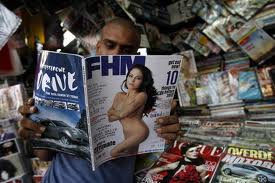
The FHM Cover: Pakistan outraged, but what about us Indians?


Here's one thing I don't understand about the FHM India controversy. Sure, Pakistan is outraged at both Veena Malik's nudity and the ISI tattoo. But what about us Indians? Isn't there any debate in India over this cover and its presence in our horrifyingly repressed Indian society? 
No, I am not a social conservative nor am I bore. Unfortunately, I am an Indian woman who has to navigate her way through the streets of India and doesn’t find it fun. Let your guard down for a minute, and there’s sure to be a random male body part brushing past you. Wear anything remotely provocative, and just the leers will make you run for cover. Even as women on screen and magazine covers compete to shed their clothes to get noticed, I find myself wishing for Harry Potter’s invisibility cloak to walk Mumbai’s streets. 
No, this is not a tirade against the Indian man and his roving hands either. I feel sorry for Indian men. They are amongst the most sexually repressed in the world and it couldn't be fun for them either. It leads to all kinds of perversities, the need to harass women on the streets being one of them.  
Lads magazine have similar covers in the West too. But they exist in a different sexual context: a context where men are not repressed and women know they can walk the streets without feeling violated. These covers merely act as a bit of fun and titillation here. 
But within an Indian context, how exactly should we view such covers, shoots, item numbers and porn stars on Bigg Boss doing pole dance numbers? Whom are they really liberating? Certainly not me, as I stand surrounded by leering men next to a Wheelers at Mumbai's train station with Veena Malik hanging naked above me. And certainly not the Indian man, for all he is getting is another image to take to toilet as he silently jerks-off to it. 
Meanwhile, Malik sues FHM for 100 million rupees, and FHM countersues her for 250 million rupees.

Friday, December 17, 2010

On Blake Edwards, Breakfast at Tiffany's and happy endings


Dear Mr Blake Edwards,

May you rest in peace. For now, I never will.

You died before I could ask you the one question that has been killing me ever since I watched your Breakfast at Tiffany’s.

Why? Why did you change Capote’s novella ending for your film? Why did your capricious Holly Golightly had to have a sudden change of heart, character and temperament in the last five minutes of the film and agree to… agree to what… a nice, suburban life with our writer hero?

It was to give us a happy ending, wasn’t it?

Was it worth it? Was it worth killing everything that Golightly stood for – free spiritedness, eccentricity, independence, risk, adventure and total and utter selfishness? Didn’t you know that she couldn’t have been as charming, funny and unique if she wasn’t all those things first? What kind of a story-teller were you to not know that?

No, no, no. I am not a pessimist. I like happy endings too. And I believe that they happen in real life. What I don’t believe is that life has sudden delightful surprises in store for us. No, no Mr Edwards, happy endings have to be worked for and people seldom escape the price of their actions or their patterns of behaviour. Capote understood that, why not you?

But you did understand that, didn't you? But you decided to go with a happy ending anyway because you thought we girls are silly, right? And you thought we wouldn’t have loved your film as much if you had Holly leave her cat and lover in a filthy alleyway and embrace the life of a fugitive. But then, if she was that sort of girl wouldn’t she have still been Paula Mae Burns married to Doc Golightly tending to animals in hick ol’ Texas?

Perhaps, we girls are silly. Perhaps, we want our cake and eat it too. But why were you silly enough to reinforce our rainbow-washed dreams? 

I wish, instead, you had taken a chance on us. I wish you had given us a real ending. Perhaps, we would have come through for you and loved Golightly anyway. But now we will never know.

Rest in peace, Mr Edwards.

For now, I never will.

Chetna

Tuesday, August 17, 2010

The Dinner Party: Or have I turned into Mrs Dalloway?

Who's afraid of Virginia Woolf? I am.
I got up yesterday in a frenzy. It was the day of the dinner, and I hadn’t even got the chicken. And the blender was broken, so I needed to pick one up from Argos.

I knew that the cashews were there, but I wasn’t sure there were enough mushrooms. We had the right number of serving bowls, but I was one frying pan short so I had to make the mushrooms first, and only then get on with the chicken. Sid had scrubbed the bathtub, and had bought the wine and the spinach so that was done. But should I get flowers for the house as well? 

It was at the flowers that the frightening realisation struck me – I had turned into Mrs Dalloway!

Now, Virginia Woolf’s unfortunate Mrs Dalloway is no one’s my literary heroine exactly. The weak, silly, snivelling woman had given up the chance of a life with real love, adventure and the struggles that accompany them for a cushy life organising parties and wondering about flowers in London. 

Ok, so my party was small and informal with only Esther-the-Lawyer and Leo-with-an-Afro (and recently turned free market supporter) coming over. But I was married, jobless in London, and worrying about flowers, mushrooms and the colour of the table mats. Did that mean that I, too, was a weak, silly, snivelling woman? Had I given up on real love, adventure and the accompanying struggles?

The thing is, I grew-up with rather fuzzy ideas about feminism. There was never much discussion about it at home or school, but I picked up enough from popular culture to know that housework – the unholy trinity of cooking, cleaning and washing – was deeply uncool and needed to be avoided at all cost. Of course, there were other elements too – being financially independent, intellectual pursuits, being an equal decision-maker in the relationship. But I determinedly decided that those could only be achieved at the cost of housework. Any man who expected me to cook, clean or wash was not worth my time.

To give credit to my parents – lovely people – they did argue that it was a conveniently lazy form of feminism that I had adopted, but at the end they just shrugged in resignation and let me go ahead with my funny experiments with life.

Sid did not expect me to cook, clean and wash. But once it wasn't expected it of me, I discovered was that I actually enjoyed cooking and cleaning (maybe, not so much washing). I love good food and  a clean house, and the easiest way to get them is to cook and clean yourself. It doesn’t have much to do with either feminism or working, because even during the months that I was working – May, June and July – I would return home looking forward to the next hour in the kitchen. I find chopping therapeutic, I love the whoosh vegetables make when I slide them into the hot oil, and the changing aromas of food as it moves through the different stages of cooking mesmerise me. Most of all, I love eating what I cook. And if I can eat it on a well-laid out table, with nice wine to accompany it, and some flowers in the house – so much the better. 

Yes, I must get a job and be financially independent. (I know I am shortchanging myself there.) But that is mutually independent of cooking and cleaning. I can be a feminist and still love cooking, cleaning, throwing parties and arranging flowers.

And I always leave the dishes for Sid to do at the end. I wonder if Mr Dalloway was as obliging.

Monday, August 2, 2010

Brenton's Boleyn - Or how I met St Anne the Martryr

Anne Boleyn at Shakespeare's Globe (photo by Manuel Harlan)
Last Monday, Sid &I finally made it to Shakespeare’s Globe – a theatre built in the original Elizabethan style and dedicated to Shakespeare’s works. Unfortunately, it wasn’t staging any of the works by the bard himself, but a modern play by Howard Brenton called Anne Boleyn. Anne Boleyn-Henry-Elizabeth-Tudors -Shakespeare: get the connection?

I must say I was also curious to see Brenton's take on Anne, especially to contrast it against Hillary Mantel’s monstrous version, about which I had blogged before.

Now, I was expecting a reasonably sympathetic portrayal of the mistress-in-question. After all, you seldom write and name a play around the villain of the show. But what I was not expecting was to be confronted with St Anne the Martyr.

Brenton's Anne is pious with just that dash of sassy impishness to make her sexy and modern to the audience. Whoever comes in touch with her – her ladies-in-waiting, the courtiers, and above all, Henry himself – simply falls in love with her. Her decision to not have sex with Henry, whilst he was still married to Catherine of Aragon, is really borne out of piousness and honesty rather than cold calculation. And most importantly, she is driven equally by her evangelical zeal to save her soon-to-be English subjects (if only bloody blockheads would agree) from the Roman Catholic Church as she is by her great love for Henry.

But what really took my breath away, was Brenton's suggestion that it was Anne’s intention to expose Cromwell’s siphoning-off for public funds – “funds meant for schools and universities” – that got her so cruelly marked and crucified. What a charming touch – and so resonant with an audience just coming out of a horrendous expenses scandal in the British parliament.

But Brenton's portrayal was essentially a dishonest one because he refused to deal with what Anne’s actions meant to another older woman and her child. Catherine of Aragon and her daughter Mary suffered – and suffered grievously and publicly – because of Anne’s determination to have Henry and the crown. Even if her actions were all borne out her desire to serve the English people, surely, these darker consequences ought to have been addressed by any play seriously asking us to change our perception of England’s most famous mistress. But Brenton coloured Anne hatred of Catherine which just that touch of childishness – she churishly keeps calling Catherine a cow – to the audience  laugh affectionately with exasperation rather than seriously question her actions.

Now Shakespeare would have dealt with Anne’s character in all its darkness and still would have us still somehow see the humanity in her. Brenton in his place airbrushes the darkness away.

Brenton’s play might be staged at Shakespeare’s Globe -- unfortunately, Shakespeare he is not.

***
- For more on the play and how to see it.It is on till August 21.

- For top ten Tudor sights in London

- I may not be pleased with this version of Tudor history, but apparently Hitler wasn't too pleased with Michael Hirst's pop television version, The Tudors, either. Enjoy!

Monday, June 14, 2010

Hilary Mantel's Anne

I wonder if I would have been as gripped by Mantel’s Wolf Hall, which I just finished reading, if I wasn’t woman, more importantly, a married woman. After all, if I am truly honest, it wasn’t Mantel’s rags-to-riches account of Thomas Cromwell’s life that kept me going through the 650 pages without a stop. No, it was Mantel’s deliciously monstrous image of the husband-stealing Anne Boleyn that had me obsessively turning over the pages.

For those who spent 2009 on Planet Pluto, Wolf Hall was last year’s Man Booker prize winner. It is a semi-fictionalised account of the life of Thomas Cromwell, an English commoner who rose to become Henry VIII’s closed confidante as he conspired to replace his ageing, dumpy wife, Catherine of Aragon, with the bootylicious Anne Boleyn. As a fall-out of this tricky wife-swapping, England broke ties with Catholic Rome, reformed the Anglican Church and accredited Protestantism in England.

Mantel remained faithful to the chronology of the actions and events. However, she let loose her imagination when giving personalities to the different characters. And boy! Is her Anne Boleyn evil? She is cold and calculating about sex, deadly in exacting revenge, grasping about wealth (read: palaces, jewellery, and titles, especially if they belonged to Catherine of Aragon) and a master at scheming. In short, she is your Grade A Mistress-From-Hell. Even King Henry VIII is a tinsy-bit scared of her. It is almost as if Mantel wants you to be standing there cheering when Boleyn meets the guillotine (for which, by the way, we will have to wait for the sequel. This novel ends with Anne’s second miscarriage and the general souring-up of Henry and Anne’s sex life.)

Strangely, Mantel even takes away credit from Boleyn where it is due. Most accounts of Boleyn – especially, if they arise from the feminist cauldron – tend to present her as a refined woman, genuinely concerned about the corrupt Catholic clergy, knowledgeable in international diplomacy, and generous towards her sister Mary. (Apparently, Anne granted her sister a life-long pension despite the fact that she was a former mistress of Henry VIII.) However, Mantel reduces Anne’s erudition to her merely passing some of William Tyndale’s writings to Henry VIII, and her experience in international diplomacy to a dinner and dance with the French King. Mantel’s Anne was a belittling bitch to her sister and she gives credit of Mary's pension to Thomas Cromwell's interjection.

To insult to injury, Mantel introduces Jane Seymour – for whom Henry VIII so spectacularly dumped Anne – as a rather simple, sweet soul with a generous heart. So good eventually won over evil, and all was well in the world again.

Why would Mantel do that? I believe she did it in order to provide maximum pleasure to her married, female readership. Can there be a purer, sweeter pleasure than in encountering the perfectly hateful “other woman” and then see her receive her comeuppance in form of beheading? After all, if Sid ever dumped me for another woman, I wouldn't be able to imagine her as anything but purely evil, and nothing short of her severed head would satisfy me. In fact, make that two ;-)

***

You can buy Wolf Hall on Amazon here.

Thursday, April 15, 2010

Name Game: Or is it goodbye Ms Mahadik?

 It is a truth universally acknowledged that teenage-hood brings trauma in its wake. For girls, it is usually connected to breasts, bras and boys. I must be the only girl in the world for whom the trauma related to a dick – a big dick at that.

I was in eighth grade when the attention of my hormone-charged class of 36 boys and girls suddenly fell on my surname: Mahadik. With “Maha” meaning big in Hindi, I was a sitting dic.. sorry duck! I faced the vicious teasing with a stoicism and non-violence that would have put Gandhi in shadow. As I kept telling myself – it could have been worse, my surname could have been “Harddik”. But secretly, I vowed to get married and change my surname as soon as possible.

The vow took 17 long years to materialise. But the strangest thing is that when finally the moment arrived to rid myself of that blighted "Mahadik", I felt an immense spurting of affection for it. For better or worse – mostly for the worse – it was my name. All my certificates, my degrees, my email addresses, my facebook name, my skype ID, and all the hundreds of articles I had written over the last seven years carried that name. Even my bills came under that name. All my friends knew me by that name. All my long, lost friends probably remembered me by that name. What if they googled my name and couldn’t locate me?

But Sid was adamant. As Mr and Mrs Prakash, we were a unit. What if someone wanted to send us a wedding invitation? Would I really want the invitation to come in the name of Mr Prakash and Ms Mahadik? Wouldn’t that be absolutely outrageous?

Faced by such impeccable logic, I quelled. Kicking and screaming, I decided to change my name.

And this month, I finally had the honour of getting my first few articles published in the name of Chetna Prakash.

One for the website Mumbai Boss, which funnily enough is about another famous name change and ensuing identity crises: that of the city of Mumbai.

Open Magazine, which is my revenge against Shashi Tharoor, ha ha ha!!!

And finally in Crest, the Saturday paper of The Times of India on art and culture.

I eagerly sent the article to a friend in Mumbai. And guess what? She replied, yah but who the hell is this Prakash woman?

Sob!

Friday, February 5, 2010

Mad Women


I finally got around to watching Mad Men on BBC iplayer: The critically-acclaimed American television drama about America in the early 1960s, as seen through lives of the men and women working for an advertising agency in New York. It recently entered its fourth successful season.

As I saw the first three episodes online, I found myself wondering that shouldn’t the show really be called Mad Women? Of course, most of the big-shots at the firm are chain-smoking, chain-philandering sexist men. But it is the women behind them – the wives and secretaries – who are all raging schizophrenic.

Think about it. Yes, they are all extremely ambitious. But all their ambitions must play-out through their husbands’ careers. Yes, they are meek around their husbands and bosses. But they are so passive aggressive. Yes, many have jobs. But none – except one, Peggy Olsen – have careers. Yes, they run immaculate households. But they must pretend that their husbands take the call on important decisions. They are beautiful, smart, intelligent, and opinionated. But they never question their role as the supporting cast in the ups and downs of their husbands' lifestory.

Just watching the show made me feel suffocated. Ambitious or not, meek or not, good housekeepers or not: at least, we are free from pretentions today. So fine, I may have my quibbles with feminist literature, but thank god the movement took place when it did.

***
Another reason for watching the show is the gorgeous period detailing - especially the office. The wood panelling, the colours of the upholstery, the clean modernist lines of the furniture and the abstract paintings on the wall - they were such elegant times. And how beautifully everyone dressed up. No one was trying to rebel against their own goodlooks. The show's worth a peek just for that. The last three episodes of Mad Men can be watched here.

Thursday, November 12, 2009

Vaginal Twist: Or how Eve Ensler got women wrong

A recent BBC report on the growing trend of women wanting designer vaginas had me thinking of the seminal play, The Vagina Monologues, by the American playwright and feminist Eve Ensler. The play written and performed by Ensler for the first time in 1996 in New York quickly catapulted to a feminist phenomenon. It inspired V-day, a global non-profit charity to oppose violence against women, which in 2009 alone has held over 4200 benefit events; a book entitled A Memory, a Monologue, a Rant, and a Prayer comprising pieces by such famous personalities as Tariq Ali, Maya Angelou and Jane Fonda; and a television film on HBO by the same name. Besides, the play itself has been performed in 28 countries covering all habitable continents of the world except Australia.

I came across The Vagina Monologues when it was performed in Mumbai, India for the first time in 2003. The play – a set of monologues by women about their different vaginal experiences – was funny, tragic, empowering and incredibly graphic. At a superficial level, it was about sexual violence committed against women. But under that, it was a larger call for women to embrace their sexuality without any guilt or shame, and vocalise their experiences and desires. In particular, I remember one of the skits, Because He Liked to Look At It. It was about how we, women, often don’t even know what our vaginas look like, simply thinking them to be ugly and embarrassing. It had a woman sit in front of a mirror and look, properly look, at her vagina.

Well, it seems many British women have taken Ensler’s advice to heart and have sat in front of a mirror to look, properly look, at their vaginas. The result: they found it ugly and embarrassing, screamed in horror, and ran to the nearest plastic surgeon to demand a better, designer vagina. As Douglas McGeorge, the past president of the British Association of Aesthetic Plastic Surgeons, described the surgery: “this is just about removing a bit of loose flesh, leaving behind an elegant-looking labia with minimum scarring”.

Hmmm... what would Ensler think about this latest vaginal twist.


***
London nugget: Ensler performed The Vagina Monologues at the tiny pub-theatre, the King’s Head, on Upper Street, London in 1999. As Ensler fondly recalled on Timesoline: “Ah, the King's Head. I had to pee in a pot because there weren't any toilets.”

Wednesday, August 19, 2009

Romancing the Indian way

Karan Johar is appalled by the way the American authorities treated his friend Bollywood superstar Shah Rukh Khan - daring to question him at the Newark Airport. After all, as Shahane in his latest blog Shoot First, Mumble Later points out, Johar has always been so kind in his intelligent and nuanced potrayals of western cultures.

That reminded me of another "pure Punjab vs wicked West" film, Namastey London, that I had the honour of reviewing for Time Out Mumbai a few years ago.

Needleless to say, Punjab came out toppers. But what really struck me about the film was the director Vipul Shah's idea of how Indian men should woo women (NRI or otherwise): apparently it involves leering at them frankly and aggressively, accosting them in a drunk state in the night, and giggling idiotically when talking to them. Treating them with respect or acting like intelligent beings around them is overrated.

The movie was a thunderous hit. No wonder, Indian men think sexual aggression is a perfectly acceptable part of romance.

If only, western men would take a few lessons from their pure-bred counterparts in Punjab.

****
Leering is sexy: http://www.youtube.com/watch?v=P6g3XPI7HRc
Accosting is macho: http://www.youtube.com/watch?v=NBtzfKGr5Fk
Idiocy is attractive: http://www.youtube.com/watch?v=gXsOy9vZQnk
Review on Time Out Mumbai: http://www.timeoutmumbai.net/film/film_details.asp?code=199&source=2

Wednesday, January 21, 2009

Gender-bender

Recently, Dr Monika Pater, a media studies lecturer with avowed feminist leanings, asked if anyone in class wanted to do a presentation on feminist literature on journalistic practice. Not one of the 11 women and four men readily put his/her hand up.

Forget the men, but isn't it surprising that at least 10 of the 11 smart, over-25, professional journalist women in our class show wariness of feminist studies?

Is it because the anti-feminists have won the day? Or is it because the feminist movement refused to move with time, to recognise its own success in improving the status of women - and dramatically of a certain section - in society?

For example, one of the papers that was eventually discussed, statistically showed how there were less women working in hard journalistic beats such as, crime, politics and business. Most women chose soft beats such as culture and features. Thus, it called for an examination into the structural barriers to women's growth in the media.

Superficially, I would be a perfect case for this study. I started out as a business journalist, but after a year and half, moved over to feature writing for an arts magazine. But are these facts enough to conclude that the world around me is a male-inspired conspiracy against women? How about the fact that I left business journalism because it bored me. Or the fact that the former magazine offered me a promotion to stay-on. Or that, I never regretted that decision. And that many men vied for my job at the art magazine.

How can we blame men for something that I chose to do and was happy to do?

Feminist literature doesn't enthuse a certain class of women because it doesn't resonate with their lives. That it is asks them to be angry for slights that they simply haven't experienced. And it expects them to blame men for things that they themselves choose to do.

Gloria Steinam, the queen-bee of the feminist movement, asked us in 2008 to believe that "Gender is the most restrictive force in American life". (If it is true of America, it couldn't be more true of India, right?) If only, Ms Steinam would use riders like "..force in a certain section of American life". By speaking for all classes and sections, she loses my support.

Speak for yourself, Ms Steinam. For I hate pretending to be the victim. And I think, so do 9 other women in my class.

Sunday, November 23, 2008

Dil Chahta Hain: Or where have all the Bollywood feminists disappeared?

Bollywood isn't exactly a bountiful hunting ground, when looking for feminist role models. I can't remember the last film in which the heroine actually worked and made a living. And the more upscale and urbane the films are becoming, the more regressive their portrayal of woman is getting.

Let's take for example, Dil Chahta Hai: the archetypical urban film, hailed by many as the first to reflect the life (and perhaps, the lifestyle) of urban India. What did the two heroines -- Preity Zinta and Sonali Kulkarni -- do in the film? Precisely nothing, beyond waiting to get married. In fact, Zinta atempts the ultimate K-serial good Indian woman act: try to sacrifice her love for her family obligations. The only woman to work was Dimple Kapadia, and we know what happened to her: she died of consumption, lonely and sad, too gutless to accept the love of a much younger man.


How about comparing these characters to that of Vidya Sinha's in the quiet, middle-class 1975 film Choti Si Baat? It is a character I find fascinating for its unfussy boldness, seldom seen in Bollywood.

At first glance, she seems like an unlikely feminist role model - Sinha sports ugly saris and hairdos through the film, a far call from the sophisticated and chic Zinta, Kapadia and Kulkarni of DCH. But think about it. Sinha is portrayed as a young, independent woman living and working on her own in Mumbai. (Her family was not referred to even once in the film.) And it is more the vivaciousness of her personality than her beauty that has her two suitors - played by Amol Palekar and Asrani - eating out of her hand.

She confidently accepts lunch date offers, and shows no misgivings about meeting her two suitors one-on-one even though she is well aware that they are trying to woo her. She has a gorgeously wicked sense of humour, and shamelessly gossips and giggles about her escapades with her friend in office. All the same, she is far from a bitch. She prefers Palekar to Asrani for being a kinder, better person.

But what I like most about her, is that it is finally she - tired of the game of one upmanship going on between the two men - who asks Palekar to cut the bullshit out and marry her. In every situation, she seems to be in more control that either of the two heroes.


I particularly think of this contrast between DCH and CSB when I look around at women in Mumbai. An American photojournalist friend, Sam, on his first trip to Mumbai a few years ago, remarked how surprised he was to see women sport jeans and tank tops with such elan in Mumbai. He took it as a sign of their liberation. In response, my thoughts immedietely went back to so many of my rich Marwari classmates in Sydenham College, who would easily fall into this liberated category based on clothes. Yet, they tamely married guys chosen by their families the moment they stepped out of college. So much for their tank tops and low waist jeans! By contrast, many of the sari-clad women jumping out the 9.00am local train and fighting their way to Mantralaya - much like Sinha in CSB - may hide Sam's liberated Mumbai woman.

To what extent, can we judge a woman's independence on the basis of their clothes?