Showing posts with label art. Show all posts

Sunday, October 5, 2014

Art, Life and Chris Ofili

The New Yorker is a cup that just keeps on giveth.

Ofili's Turner Winner
Last Wednesday, it published a fabulous profile of Chris Ofili. And today, the New Yorker has dug up seven artist profiles from their archive, which specifically look at how their life and experiences have informed their art.

Chris Ofili is the British artist of the elephant dung fame. Of course, it is only when I read the article I learnt how much more than that he is. The writer visited him at his home in Trinidad, where to he has moved with his family since 2005, and built a profile by weaving his life story and career with little details of his current daily life.

What struck me was how much the British artist reminded me of Barack Obama. Here are the things they share in common: an absconding father, a strong mother, immense intelligence and self-confidence, and an ability to carry their blackness so lightly. Yes, they are black but they are so much more.

That is how I feel about being Indian. Yes, I am an Indian but I am so much more.

The work of any artist is intimately connected to his life, experiences and times. His race, sex, history, friends, surroundings, travels and his own take on these experiences is what defines his works. When that take is unique, the works can be astonishingly revealing. However, when an artists take on his life experiences is derivative - meaning, I am lesbian woman artist hence, I make this etc... I am an Indian artist, hence I make that etc... - the works become cliches.

Ofili is clearly a case of the former. His ethnicity, his Catholic upbringing, his travel through Africa, his love for hip hop, and his life in Trinidad: they all inform his works but what shines through is his relation to these experiences.

On the other hand, I feel that latter is the case with a number of Indian artists. The overt political commentary their works make about Indian life somehow doesn't leave enough room for them to explore their own position vis-a-vis the society they are commenting on.

So now my goal for the week is to read the seven profiles and use them to further my understanding of why I find overtly political Indian artists somehow unsatisfying. The one I am most looking forward to reading is Damien Hirst's.

Saturday, January 15, 2011

Otolith Group and the bane of being intellectual

Otolith III at Tate Britain
I wrote an article about The Otolith Group, the British artists who were nominated for the Turner Prize this year and are now showing in India. It was commissioned to me by TOI Crest in October, I actually did it in November and it is out in January - talk about gestation period.

You can listen to the entire interview here, if you have the patience for it. Despite my misgivings about my voice, I am putting it out there because I really enjoyed interviewing them. Besides, raw date is all the rage these days, you know. What with Wikileaks and all.

Interviewing The Otolith Group by chetna prakash

Guardian called their works "unabashedly erudite". Some other papers, were less charitable calling them pretentious. I could sense Eshun's blood pressure rise up a notch, when I asked him the question. And he went on a lengthy explanation about the difference between complex and incomprehensible, and why should their works be about one simple idea, in the first place. Wouldn't that be boring?

When did we turn into a society where one has to defend oneself for being erudite and intellectual.

Look at Barack Obama, throughout his presidential campaign he had to constantly play down his excellent education, his obvious intelligence, his articulateness. And in contrast, Sarah Palin was constantly playing up her gal-next-door credentials, her homilies and claims to common sense. She still does, and it seems is still very popular. While Obama is still struggling to get himself heard and understood.

Another obvious trap is to be entertaining. As Andrew said to me while we were discussing our favourite film critics, you must be funny. Being intelligent is not enough. You must be entertaining. That's the only way you can get your point across. But isn't there a joy to engaging with the difficult, figuring it out and feeling good about it. What's wrong with being sincere, anyway. Isn't that a good thing?

Obviously not. Otherwise, The Otolith Group would have won the Turner Prize.

A funny, funny world we live in.

Wednesday, December 8, 2010

On Philipsz who won the Turner Prize and Otolith Group who should've


Susan Philipsz and her sonorous sound artwork Lowlands Away has won the Turner Prize 2010, and it is so hard to quibble with the judgement. Her spare work is more than just about her sweet, untrained, incredibly haunting voice. It makes you think of music in terms of volumes, shapes, movements and spaces rather than merely sound and thus transcends to sculptures, as they are often called.

Yet, quibble I must. For I wanted the Otolith Group to win, which considering my utterly bewildered first reaction to their works at the Turner Prize exhibition is surprising. Their works are not easy. As Adrian Searle, the guardian art critic commented in a video-article: “they are throwing a big fat, heavy book at you and saying - read this, look at this.” But the point is if you do read this big, fat book, as I did – if you engage with the works, read and think about them, go back and review them – you’ll find yourself filled with all kinds of novel ideas about reality versus fiction, story-telling, images, memories and how they are affected by time and distance. Layer upon layer of meanings and ideas will unfold as you start digging into their works.

Let’s look at Otolith 3 – a film they made in 2009 which is currently being exhibited at the Turner Prize exhibition.

The artists began with a whimsical idea – what if four characters from an abandoned film project called The Alien by Satyajit Ray stepped out of the script and demanded to know why they were never made. Then they created a voiceover script for these four characters plotting of ways to accost Ray, take him to task for abandoning them, and find a way of making the film for themselves independently. Their narrative plays to a dreamlike video that stitches together film footage from Ray’s films from the ’70s, footage of London shot by Sagar’s father in the ’60s, and more by Eshun and Sagar shot in the ’90s.

At a very basic level, the artists are interested in the haunting, unsettling presence of ideas and projects which were once talked about with vigour but never realised. What is their status in our lives – are they real because they live in our minds, or they are unreal because they never came into being? They are interested in the anxiety and frustration that the unfinished leaves inside us.

But it is the clever way in which the artists use film and images and painstakingly combine them with audio to create that sense of haunting and powerlessness inside us that takes their work to the next level. The carefully selected images and footage, the way they are edited and put them together in a loop – each time returning to the same image and story, but with a slight difference – makes us, the audience, experience the anxiety they are talking about and not merely think about it. Indeed, they have a mastery over the medium they are commenting on.

Their works are no less haunting that Susan Philipsz, but they manage to combine several more media, ideas and thoughts about story telling, narratives and film-making into them.

Some art writers like Jonathan Jones have dismissed their works as pretentious and indigestible. But as Eshun said in an interview that I did with him: “pretentious for us just means a work that aspires to make statements about the condition of reality that we all live in”. But Eshun and Sagar don’t just aspire to make these statements, they actually manage to make them through their works.

As I said, I didn’t get their work at first go. But, upon suitable reflection, I digested them and found them rich and intriguing. Perhaps, Jones just didn’t bother to ponder over them long enough.

The Otolith Group's works are serious, challenging and decidedly unspectacular. But what's wrong with serious anyway? To me, it only reflects the serious, challenging and spare time that we are all facing.

***
For those more interested in The Otolith Group, here is a podcast of the raw interview I conducted with the Group over the telephone.

Interviewing The Otolith Group by chetna prakash
***

Wednesday, November 24, 2010

FT, Martin Parr and whether ex-Mumbaikars suffer from post-traumatic stress syndrome

I finally got around to reading the FT Weekend Magazine on my way back from Paris.

The tantalising cover and the bold “Seven Days in South Asia” had me most excited. I mean, how often do you see a North Indian woman in a violent pink sari and comic sunglasses on the cover of FT?

Unfortunately, the story was a let-down. It was written in the style of a diary of the FT editor Lionel Barber about his weeklong trip to India and Pakistan. During the eight days – yes, it was eight days but I guess, “Seven days in South Asia” just sounds better – he essentially hobnobbed with the rich and the powerful of the two countries starting with the governor of West Bengal, followed by Mamata Bannerjee, Mukesh Amabani, Anil Ambani, Anil Agarwal of Vedanta Group, Ananda Mahindra, Ratan Tata, PRS Oberoi of Oberoi Hotel, the Ruias, Jyotiraditya Scindia, Manmohan Singh, the governor of Punjab Salman Taseer, and finally Asif Ali Zardari. As all these interviews had to be reduced to a four page story, what we get is mostly his impressions and a few quotes to support those impressions. All that is fine by me. But why the comic, cheeky cover image which suggested insights into the self-perceptions of ordinary Indians? To me, the cover seemed disingenuous and misleading.

The image was shot by Martin Parr. Chirodeep, a photojournalist friend of mine, had first told me about him. Then in a space of a week, I found myself gazing at this works twice. First on the FT cover, and then again at an exhibition at Maison EuropĂ©enne de la Photographie, which was a part of a month-long photography festival in Paris. Parr’s photographs at the exhibition were from one of his early acclaimed series published in 1986 about British tourists holidaying at Brighton.

The exhibition was about extreme photography: or images that pushed either the photographer or the audience to the extremes of their physical, social, imaginative and/or emotional abilities, and how just by doing so, made the experience a little bit mundane.

Which is why this image by Gabriele Basilico stayed with me for long after I had left the exhibition. It caught my eye the moment I entered the room, mostly because from a distance it looked like Mumbai to me. A densely packed neighbourhood with mid-rise buildings in a semi-ruinous state, where else could it be? It turned out to be shots of bombed-out Beirut from 1991. But honestly, even at a closer look, it kind of looked like Mumbai on an ordinary day to me. It was appalling to think that we Mumbaikars live in what most people would consider “extreme conditions” on an everyday basis.

But don’t extreme conditions come with some form of associated trauma? Which makes me wonder whether I am suffering from post-traumatic stress syndrome, now that I am not living in Mumbai anymore?

What would its symptoms be? If I had to guess, they would be:
A)    A rush of joy at the sound of traffic noise
B)    Tap water-related paranoia
C)    Morbid fear of silence
D)    And a constant bursting into happy tears at the sight of crowds

If you have any other suggestions, feel free to leave to use the comment space.


Wednesday, October 6, 2010

Me & the Bean Talk

There are few things that immediately turn me into a child. Sculptures by Anish Kapoor – especially the large, tactile, abstract ones – invariably do.

Which is why I landed up visiting the Millenium Park thrice during my two-week stay in Chicago. Just so that I could stare, touch and fool around with The Bean (or Cloud Gate, as is its official name that nobody uses) – the giant, bean-shaped, silvery sculpture by Anish Kapoor that sits in the park reflecting the amazing towered skyline of downtown Chicago.

After attending a retrospective of his works at the Royal Academy of Arts, I had written in a blogpost: “The material and colours somehow invited you to touch them, stare into their curving holes, pose in front of its shiny surfaces, hop over them, slide under them – and just fool around with them. The museum staff was having a tough time stopping people from doing just that, even though, I wonder if Kapoor would really mind. The works looked too solid to be easily harmed by anyone.”

Well, there was no museum staff to police people here, and boy, were they fooling around with the sculpture? You could see people being attracted to its shiny, curved reflective surface almost against their will. They would stare at it, crawl under it, run their palms on its smooth surface, and then slowly the camera would come out and they would go nuts shooting their own distorted reflections, or in my case, taking post-modern pictures of me taking pictures of Sid, which he has expressly forbidden me from publishing on this blog.

The work did exactly what good public art should do – get people curious, interested, fascinated and, at the end, exhilarated.

According to Wikipedia, the people of Chicago started referring to the sculpture as The Bean even before it was fully unveiled, thanks to its inverted bean shape. Kapoor thought the name "completely stupid", and went on to name it Cloud Gate. Of course, I didn't come across one person in the city who called it that. But then again, looking at his amazingly tactile works, one would imagine that Kapoor made them specifically for people to physically interact with. Yet, as Girish said in a comment to my previous blogpost, he absolutely hates the public touching his works. The fact that the people anyway call his work The Bean and continue to touch it in fascination goes to show how the city has appropriated his sculpture. It is a measure of how this public work of art has truly gone public. Would Kapoor have wanted it any other way?

Monday, October 4, 2010

Kallat in Chicago: Or you just can't escape India anywhere

Step-by-step Kallat conquers the world

I went all the way to Chicago, and guess what – the first article to catch my eye, when I opened the Time Out Chicago website, was one recommending a view of a public installation work by Jitish Kallat entitled Public Notice 3 at the Art Institute of Chicago or ARTIC. (ARTIC, by the way, houses such greats as Nighthawks by Edward Hopper and American Gothic by Grant Wood.) Never one to let a story go to waste, I quickly charged my dictaphone and set out to view the work and interview the curator. The article appeared in this week’s TOI Crest, and you can read an online version of it here.

What is interesting, and which I didn’t get a chance to discuss in the article – word counts are such a bummer! – is how the work actually got made.

So for those not keen on reading the Crest piece, this much should suffice to understand the work: “The installation links two important events in American history. The first is the landmark speech delivered by Swami Vivekananda calling for an end to “bigotry and fanatism” at the opening of the first World’s Parliament of Religions, on September 11, 1893, held at the site of the Chicago museum. The second is, of course, the terrorist attacks on the same day, 108 years later. Kallat has recreated the entire text of Swami Vivekananda’s speech on the risers of the main staircase of the museum using LED lights in the five colors of the US Department of Homeland Security alert system—red, orange, yellow, blue and green.”

However, I imagined Kallat playing a critical role in the creation of the installation. When we hear that the installation is by So-&-So, we still conjure-up visions of the artist painstakingly hammering away at his sculpture / installation. Actually, Kallat’s main role regarding this work pertained to conceptualisation. The museum curator, Madhuvanti Ghose, then found a company that specialises in making art installations, gave them the specifications, and worked with them to bring the installation to life. Kallat was consulted over phones and emails. Throughout the course of the installation’s creation – which was roughly a year – Kallat only made an appearance in Chicago once. That was in August this year, a month before the show’s opening, when the installation was ready for a mock-up.

I wonder if any credit needs to be given to the company that actually produced the installation as per the specifications received. None of the literature accompanying the work mentions them. Ms Ghose in the interview said that it is well-known within the artistic community of Chicago, so I am guessing, they don’t as such need the marketing mention. But do we as the viewers need to know who actually made this work, apart from who conceptualised it?

I am not asserting that the installation not being hand-made by Kallat in any way diminishes it. It does not: the work fully and completely remains his. But does the museum or the artist owe it to their viewers to make the process of the making of the artwork transparent to the viewer?

What was also interesting was that the installation – that is so custom-made for this particular site – can in fact be loaned to other museums. Only, it would have to be built from scratch for the borrowing museum. Ms Ghose said that the site of its display will have be relevant, since much of the artwork’s meaning is derived from the site of its installation: the staircase opposite the Fullerton Hall at ARTIC, the exact spot where Swami Vivekananda made his speech on September 11, 1893. However, I wonder, if the artwork is so site-specific, how can it ever be recreated elsewhere without either losing its meaning or donning a new meaning. Would it not then be a whole new work?

After all, if it weren’t for its site-specificity, wouldn’t the art-work simply be Detergent: a very similar text-and-light installation – with the same speech and colours – on the staircase of the Guangdong Museum of Art in China, that Kallat made last year?

***
I have created a soundslide – my first – of Kallat’s installation. All images except the first one are courtesy the Art Institute of Chicago. (PS: The triumphant Star & Stripes music is meant to be tongue-in-cheek, and yes, I know there are typos in the video text. I didn't realise that I wouldn't be allowed to edit once the video was made. Sorry about that.)

Kallat goes to America on PhotoPeach

Thursday, August 19, 2010

The Foto8 Summershow 2010: Or why I'd give Poulomi's exhibition a go

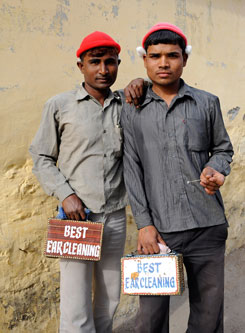
Best Ear Cleaners by Nick Cunard
Poulomi messaged excitedly on Tuesday. Her photo was being displayed at the foto8 summershow exhibition at the Host Gallery, and she wanted me to come for the opening. “There’ll be wine, canapĂ©s and lots of industry people,” she said by way of enticement. I didn’t go. Because Sid came back home looking rather miserable, and I didn’t want to leave him alone to noodle soup and bbc iplayer. (What to do? I like Sid, he’s nice to me.)

But l am also a loyal friend so I diligently registered my footprints at the exhibition the next day.

What took me by surprise was that 15 of the 153 works of photojournalism on display were shot in India – meandering between Kashmir, Rishikesh, Varanasi, Bhopal, Rajasthan, Ahemdabad, Jharkhand, Mumbai and Goa. No, no, they were not shot by Indians, silly heads, only shot in India. There was only one photograph actually taken by an Indian, and the honour went to my friend, Ms Basu (pronounced Boshoo, thank you.)

Now, I dislike whining postcolonialists enough to agree that yes anyone – Indian or otherwise – has the right to come to India, take our pictures, and display them in London galleries. And they should be allowed to shoot what they think is interesting, and celebrate it as such. What I was interested in was what I, as an Indian in a London viewing these images, should get from them? Do they observe and single-out things that I as an Indian – born and bred in India – do not or cannot notice myself?

The first image of India that caught my eye was of the ear cleaners of Rishikesh? Oh no, I thought. Aesthetics aside, haven't I seen ear cleaners being shot and documented (as a lovely, quirky anachronism) by other Indian photographers already?

Next came the train ride. Ok, nice enough shot but as social documents go the great Indian railway journey is a bit overdone, I think.

The three shots of Bhopal Gas Victims. Well, at least it keeps a controversial, unresolved issue in the limelight.

I began to get intrigued when I found myself face-to-face with a black-and-white close-up of a school girl from Varanasi – her face tightly framed by her ungainly woollen scarf. Shot by Kathryn Obermaier, the portrait reminded me of how I used to dress with no sense of fashion whatsoever when going to school – hair tied in tight plaits, red ribbons, long skirts, long socks, oily hair, tight woollen scarf and a deadly scowl. If I looked anything like her than I was absolutely lovely in my unassuming ugliness. I’m glad such innocence lives on.
Courtesy: Poulomi Basu

Poulomi’s photograph of the women of the Indian Border Armed Forces as they trained before being deployed to the line of control between India and Pakistan stood out too. Who would know, if it wasn’t for Poulomi, that such a battalion exists. Yes, a battalion of women soldiers in a country where women are still being burnt alive for dowry! Nice contradiction, isn’t it? I couldn’t help but wonder what went through those bodies and minds, and Poulomi’s image gave a glimpse.

I also loved Helen Rimmel’s portrait of Azim Tuman, the chairman of the houseboat association in Kashmir. Houseboat Association? Houseboats? I can’t remember the last time, I thought of beautiful things when someone mentioned Kashmir. And yet, the remnants of those old, beautiful, half-happy things perhaps lay scattered all over the valley and pop-up in photographs like this one.

The others included images of illegal mine workers in Jharkhand (that cesspit of India), ganges (a bit ho-hum), and a couple of intriguing shots by Shiho Kito.

So shot by Indians or not, I'd say the exhibition does give an intriguing glimpse into India.

***
The exhibition will be on till September 4 at Host Gallery, 1-5 Honduras Street, London EC1Y OTH.

Tuesday, August 3, 2010

CSI Reloaded - Or how England recovered a Rapahel

Madonna of the Pinks at the National Gallery
 This week's edition of The Times of India Crest carries an article by me on how the National Gallery in London uses highly speciliased scientific techniques to verify artworks - very CSI!!!

For example, this lovely work on the side is entitled Madonna of the Pinks. A renaissance-period work it was considered a copy of a Raphael and was sentenced to a century of obscurity in a castle far away in Northumberland. Then, while getting its 100-year cleaning someone noted its masterful execution and sent it to The National Gallery for a check-out. The gallery took out its electron microscope, infrared radiogram and mass spectometer to uncover the line drawings underneath.

Voila! Turns out that both the material of the line drawing and their style was doubtlessly characteristic of  the great master Rapahel himself.

The painting now owned by the National Gallery and is currently on display at an exhibition Close Examination: Fakes, Mistakes and Recoveries. The exhibition displays more than 40 such paintings whose authorship was in dispute until super-sciences were used by the Gallery's laboratory to verify the claims and counterclaims.

***
Have you seen the Audrey Hepburn-starrer How To Steal A Million? It was the funnest film on fake art I've seen. Here's a trailer:

Sunday, May 16, 2010

Don't worry Quinn, it is not a freak show

Can someone sculpt a life-size bronze statue of a woman-with-a-penis fucking a man-with-a-vagina, doggie-style, and then claim that he doesn’t want his exhibition to be viewed as a freak show? Yes he can, if he is  artist Marc Quinn. The claim was made in an interview to The Guardian on May 1, just before his latest show - displaying the said statue - opened at the White Cube gallery.

The statue has been cast from two real-life pornographic actors: Allanah Starr (a man who surgically became a woman but decided to keep his penis) and Buck Angel (a woman who changed into a man but decided to keep her vagina because she didn’t want to lose her orgasms, as she explained to The Guardian).

Other works include a marble statue of Chelsea Charms, a woman with enormous, surgically-enhanced breasts who is an adult “breast entertainer” for the pornographic industry; a towering marble of Thomas Beatie, a pregnant man; two large, pop-ish busts of Michael Jackson playing on the “Black or White” theme; Pamela Anderson sculpted to perfection, in real life and in bronze; and more.

I had only heard of Quinn’s works in passing before – Self, a bust of himself shockingly made using his own frozen blood, and Alison Lapper Pregnant, a naked marble sculpture of a pregnant woman born without hands and feet. I hadn’t seen either, but the first sounded interesting and the second – simply noble. I had to see his works in real, which I finally did this week.

Unfortunately, there isn’t much nobility on display in this show – except, perhaps, in the sculpture of Thomas Beatie, the pregnant man. Beatie’s sculpture stands out because of the astoundingly gentle expression that radiates off his face – as he softly runs his palm over his swollen belly. The expression said more to me about the beauty of mother’s love than the countless medieval Madonnas that I have viewed in museums across Europe. By capturing that expression on Beatie’s incongruously bearded face, he instantly transformed Beatie from a freak into something close to godliness – and to me it was a revelation. 

But I can’t understand how sculptures of Starr fucking Angel or of Chelsea Charms looking up in ecstacy as she strokes her monumental breasts help us understand them and their choices more, let alone identify with them?  If anything, it further alienates them, since they are already pornographic actors and presumably used to putting up such displays for people’s pleasure – often freakish pleasure. It is not particularly courageous of path-breaking to allow themselves to be sculpted so. On Quinn's part, by presenting them in such poses, he has only confirmed the stereotypes of transgenders.  

Were it not for Beatie, I would have found Quinn’s show boring. And since boredom is not a sentiment any good freak show aims for, perhaps, Quinn has achieved what he set out to do.

Sunday, February 14, 2010

Empire Strikes Back - with a few borrowed footmen


Refusing to judge the current exhibition at the Charles Saatchi Gallery by its rather gimmicky title – Empire Strikes Back: Indian Art Today – Sid and I decided to make it our Valentine's outing. And I must say it was fun. It had the works fo 26 different contemporary artists, which together presented a colourful mix of different genres: from small, delicate works to huge paintings and installations. It is ironical and a little sad that in all my years in Mumbai, I never came across an exhibition with such a huge, varied mix of contemporary Indian art as I did today in London.

However, I am as curious as Girish to know why did they bung in three Pakistani artists into the exhibition on Indian art? Was it because the curator simply thought that the term “India” can stand for the whole subcontinent? And even if it did – which it doesn’t – is he trying to say that there are only three artists in Pakistan producing the quality of work comparable to their Indian counterparts, and hence worth exhibiting in the space?

Another tendency that I find a tad troublesome is categorising foreign born and bred artists as Indian artists simply on the basis of their Indian lineage. One such artist is 28-year-old Ajit Chauhan, who was born in Kansas, US, and now lives and works in San Fransisco. The exhibition includes a work composed of 160 old record covers from the 80s (see above). Chauhan has painted over the faces on the covers, which was funny in a disturbing sort of way, but had no connection to Indian popular culture whatsoever. I don’t think his name rings a bell in India, he has never exhibited his works there, and none of his works that I came across over the web refer to India in any way – so why is he a part of Indian Empire striking back? At least, the works of Chitra Ganesh, Shezad Dawood, Schandra Singh refer to India or their own Indian origins in some way. But I can’t say the same of Yamini Nayar or Ajit Chauhan.

I have only been outside of India for two-and-half-years, but already I feel a little doubtful commenting on the daily politics and cultural happenings back home. The subjects are so complex and tied into so many everyday realities that unless I am experiencing them up, close and personal, I don’t want to pass judgments on them. And I am aware that the longer I stay out of India, the more tenuous my connection with the country will become. But in turn, I hope to build new connections and understandings of the cultures and people I encounter outside of India.

Just like I wouldn’t want to pigeonholed as some kind of representative Indian writer, if I am not living in India, I wonder how comfortable Chauhan feels being branded as a contemporary Indian artist.

Friday, February 12, 2010

The Year through a Kaleidoscope


The World Press Photo Awards for 2010 have been announced. Started in 1955 by a group of Dutch photographers, the annual award has become the most coveted in the field of photojournalism. The winning entries are also exhibited across 45 countries through the year so as to maximise the opportunity for people to view them no matter which part of the world they live in. This year the tour will cover countries ranging from the usual suspects such as The Netherlands, Germany and the US to such far flung corners as Zimbabwe, Tunisia and Ukraine.

One reason why I never miss going through the catalogue of winners each year (in person if possible, otherwise over the internet) is because it is like looking at the world last year through a kaleidoscope. Some events you couldn't help but know of, others may ring a bell, and then there are those that come as a complete surprise. For example, the drought in Kenya last year, a photo of which won Stefano De Luigi the first prize in the contemporary issues category. Or the rioting in Antananarivo, Madagascar in February 2009. Antananarivo? When? Where? What? But now, I will probably look it up.

The photos will be exhibited in Edinburgh, UK between August 3rd and 28th. (And in Perth from 20th March to 18th April, Brisbane from 5th to 27th June, Sydney from July 9th to August 3rd.)

***
You can hear one of the jury members discuss the winning image here.

Wednesday, February 3, 2010

Osian's - going, going, not gone yet?

Last week I met Aqdas Tatli, who is doing an MA in Art Business from the Sotheby’s Institute of Art in London, and over dosas had a robust debate on whether art is art or is it just another commodity. (If he doing his master’s in art business you can imagine which side of the debate he clearly stood.)

Soon after, I read this great article in Forbes magazine about the woes of Osian’s, the world’s second largest art fund started by Neville Tuli in my humble Mumbai. It is threatening to go belly-up thanks to Tuli’s wild gambles leaving several high-profile investors left moaning. Tatli is making a presentation on Osian’s in his class (and I am hoping to sneak in).

But my point is, yes, art is a commodity. But isn’t it a consumer-durable kind of commodity? You must buy it because you like it, appreciate it, enjoy it and get some pride out of it. You don’t buy it because it will someday make lots of money for you. That said, it does carry a chance with it that someday it might turn vintage, and make a pile for you in the process.

Can we equate art to an investment commodity? The success of both art and financial instruments as an investment depends on some solid predictable indicators interacting with some unpredictable ones. In case of financial instruments such as shares and bonds, the predictable economic and physical indicators such a healthy capital investment, a balance sheet that makes sense, business plans that are clearly based on the prevailing business, political and economic environment are in tension against unpredictable elements such as wild human behaviour, natural disasters, accidents etc. In case of art, the predictable factor such as the marketing machinery behind an artist interplays with unpredictable elements such as current fashions, tastes and the artist’s creativity and ability. But I do think, that in case of the latter, the balance is deeply tilted on the side of the unpredictable indicators.

Which is why, if I ever have any money to buy art I will follow the advice by a wise bald gentleman called Girish Shahane. Yes, invest in art but always buy something that you like. So that if its price doesn’t rise as predicted, at least you are left with something on your walls that you enjoy and appreciate.

***
South Asian art is making its presence felt in London at two venues. First, Saatchi Gallery has a huge exhibition on Indian and Pakistani art (paintings, installations, sculptures, you name it) entitled The Empire Strikes Back: Indian Art Today. Second, the Whitechapel Gallery in East London has an extensive exhibition on 150 years of photography in South Asia. There’s your art for a bargain, oh Londoners!

Sunday, January 3, 2010

Wright & Wrong


There was a certain kick in catching Richard Wright’s gold leaf and gouache mural that won this year’s Turner Prize in the very last hour of its existence. Tomorrow, this ethereally beautiful creation will be heartlessly painted over at the express request of Wright. It is not a gimmick. It has been the fate of all of Wright’s works in the last 20 years to be destroyed at the end of the exhibition for which they were created.

As he said in a video that accompanied the exhibition, “I like the idea of there being nothing left when I am gone”. Wright also acknowledged that his art sits awkwardly with the market. It questions how the system should value his art, which though exquisite, is transient. How should the art market – the auction houses, the galleries and collectors – contend with Wright’s work, which has no resale value? Is it still worth patronising?

Questioning art and commerce is not new. Another Tate exhibition – Pop Life – is filled cheek-by-jowl with artists questioning this rather murky relationship: from Andy Warhol to Tracy Emin and Damien Hirst. Almost all of the works did the same with a sense of cynicism, irony, starkness and in-your-face shamelessness that unfailingly ensured that the artists’ pockets are lined with gold. So while you definitely came out enjoying their joke on the system, you couldn’t help but feel that somehow the joke was also on you.

I prefer Wright’s style of questioning. It doesn’t just poke fun at the system, it boldly challenges it. His works also challenge us as a society to question our consumerist covetousness and fascination with youth. But Wright does it with a sense of almost spiritual beauty. For in order to destroy your own exquisite creation, you must first let go of the vanity and conceit that accompanies its creation. That Wright does it, gives us faith that so can we.

***
Wright’s work is gone forever. But Pop Life exhibition will be on at Tate Modern till January 17.

Monday, December 21, 2009

Whore art thou!


Yes, Hoerengracht did capture that curious mixture of seediness and banality of Amsterdam’s sex district, as I had hoped it would.

Look out for the window with the prostitute contentedly lounging about reading a gossip magazine in her lingerie surrounded by ordinary bric-a-brac – a radio, a ring-dial telephone, a vase of wilted flowers, and a poodle snuggled under her feet. Hardly the image of a prostitute vending her goods!

But it was Amsterdam of the 80s. Twenty years don’t seem much on paper. But to understand what they mean in terms of the little details that surround our lives, visit Hoerengracht. It means a total overhaul of all the concept of design surrounding us – the clothes, the wall paper, the radio, tvs, telephones and other household gadgets, even our image of a beautiful body has undergone a complete transformation. Were it not for the semi-naked models confronting us, Kienholz’s sex district would seem like a quaint relic of the past.

Don’t miss the documentary that plays alongside about how Ed and Nancy came about making Hoerengracht and why is it such an important installation of our times. What struck me was the humour and sense of fun with which they worked on it. It is always a joy when you find an artist who can laugh at himself and his work, while discussing it intelligently.

***
The show is on at the National Gallery till Feb 21, 2010. And Sid and I were pleasantly surprised to find entry free.

Thursday, December 3, 2009

Art of Portraiture


One the last things I did in Amsterdam was to visit the World Press Photo exhibition with Sulakshana in June last year. The World Press Photo is a worldwide photojournalism contest that was started by a Dutch group of photographers in 1956, which over the years has rewarded some of the most iconic images of our recent history. Think the baby with glassy eyes that embodies the Bhopal gas tragedy of 1984 or the lone man standing in front of tanks at the Tiananmen Square in 1989, they’ve all made it to the top of this contest.

The exhibition that I attended was of winners of 2007. One particular photo – the winner of the portraiture category – had us intrigued. It was a portrait of Vladimir Putin, which at first glance looked no more than his “mug shot” as Sulakshana elegantly put it. It was an intense close-up of Putin’s face against a light blue background that had appeared on the Times magazine cover. Of course, both of Sulakshana and I were photography novices so it was difficult to gauge on what grounds this portrait, and not the thousand others, won.

The reason became clear from the audio commentary by Platon, our alleged mug-shot taker, which accompanied the photograph. Platon first explained that it was probably the only portrait shot of Putin in existence. He is notoriously difficult to gain an interview with, and nobody before him had managed a personal one-on-one photo shoot. The Times magazine had initially been told that they would only be allowed to take Putin’s pictures as he was being interviewed for the article. The magazine’s request for a separate photo shoot had been denied. So essentially, Platon had few minutes after the interview to convince one of the most powerful and intimidating men in the world to sit for a photo shoot that he was reluctant over. And if he managed that – another few minutes to set up his camera, build a rapport with the famously cold president, and get a portrait that would do justice to both Putin’s stature and the Times cover.

And Platon achieved just that, and in style. The candour, ease and intimacy of that portrait is striking simply because the circumstances in which it was taken fought against those exact qualities. In that sense, the portrait deserved to win as much for what it told about Putin, as for what it didn’t tell about the difficult circumstances in which it was taken.

I was reminded of Putin’s portrait today because the latest issue of the New Yorker carries a slide show of portraits of world leaders taken by Platon recently during the UN summit. It is an amazing slice of history, of course. But the engaging audio commentary by Platon that accompanies each portrait also makes us understand and appreciate this difficult art much more.

***

The archive on the world press photo website is an amazing repository of world through the camera in the last 60 years. A definite must for journalism, photography and history lovers!

Monday, November 30, 2009

Some things matter

Visited White Cube Gallery at Hoxton Square and Mason’s Yard to see Damien Hirst’s latest exhibition – Nothing Matters.
The works focussed on crows and rather fetching skulls (see picture above). But before you get excited, there was no formaldehyde, diamonds and precious metals in the picture. In keeping with the recession, Hirst has scaled down his works to mere paint on canvas. (Though he couldn’t resist pasting real crow feathers on to the paintings).

Interestingly, the exhibition opened on Tuesday, November 24. The very next day BBC Four broadcasted an investigative documentary The Great Contemporary Art Bubble by art critic Ben Lewis. The documentary traced the unprecedented rise in the prices of contemporary art in the last decade, and particularly in 2007-08, examining how much of it was mere speculation. Hirst and his patron gallery White Cube figured rather prominently in Lewis’ firing line.

The documentary is worth viewing because it tries to examine the role of the artist-gallery-auction house nexus in raising and maintaining the prices of contemporary art works, and why the general public should care about it.

According to Lewis, money matters in the art world – it really matters, and don’t let Hirst tell you otherwise.

***
The documentary can be viewed for another five days on the BBC website. Hirst’s crows and skulls that don’t matter will be on view till January 24 at the White Cube gallery.

Saturday, November 28, 2009

Kapoor's Land of Wonder

Anish Kapoor's retrospective at the Royal Academy of Arts on PhotoPeach


Visiting Anish Kapoor’s exhibition at the Royal Academy of Arts yesterday was like experiencing the Imaginarium of Dr Parnassus again – without the long boring story and characters to distract this time.

The artworks are difficult to describe precisely because they don’t resemble anything real that I have seen. They were all about material, form, size, shapes and beautiful, vivid colours. As we entered, there was an undulating rust-coloured metal cavern of gigantic proportion that filled up the whole hall. And then, there was a huge block of wax in rasberry sorbet colour that slowly made its way on rails between different rooms, its shape being cut out of the curved marble doorways it passed through. Or my favourite: a gigantic wall smoothly curving inwards in the prettiest shade of yellow. It reminded me of nature’s landscapes and Disney fantasies all at once.

And the material and colours somehow invited you to touch them, stare into their curving holes, pose in front of its shiny surfaces, hop over them, slide under them – and just fool around with them. The museum staff was having a tough time stopping people from doing just that, even though, I wonder if Kapoor would really mind. The works looked too solid to be easily harmed by anyone.

I also loved the disregard with which the hallowed, imperial halls of the Royal Academy were being treated. Like the giant paintball sending canons of red colour at fifty miles per hour on the white, white walls of the Academy. Or the coloured wax block cutting through the archways and dropping slimy wax all about the pristine marble floor. It seemed sacrilegious under the ornate ceilings and cold marble of the academy, and somehow gave you a guilty, but immensely satisfying, kick.

Fun is what his works were, and if the squeals of joy and surprise, the anticipation, the gaping mouths and wonder-filled eyes around me were any indication – they achieved their purpose.

(Images courtesy: Peter Macdiarmid/Getty Images Europe)

Wednesday, November 18, 2009

Critical Findings

I have a lot of respect for art critics. They often find references, connections and ideas in the art works that leave me amazed. But there are also those times when I am left thinking - hmm... Is he kidding me?

This unnamed art installation by Irina Korina (I love the sing-song quality of her name) at Bloomberg SPACE has been described by art critic Max Seddon in the accompanying leaflet as resembling a "jellyfish, Kraken, spaceship or enchanted tree".

Really?

Jellyfish - ok, I hadn't thought of it, but now that Seddon mentions it, I see the resemblance.

Kraken - well, isn't that a kind of monster jellyfish anyway?

Enchanted tree - Why? Because there are dead leaves and branches scattered about?

Spaceship - Now, I must protest on behalf spaceship lovers. Spaceship it is not! I don't know what science fiction Seddon watches but spaceships do not and have never had Chinese lanterns on their heads.

A lamp on an abandoned gazebo in autumn is what it most reminded me of - but then again, that is exactly why I am not an art critic.

***
Visit and judge for yourself: Korina's work is displayed at the Bloomberg SPACE till November 28.

Tuesday, November 17, 2009

Bloomberg Blooper

Someone must tell Bloomberg LP that it is bad corporate branding for a company whose essential business is packaging and disseminating information to do such a poor job of explaining the art exhibits displayed in its art gallery housed in the company’s London office.

First, despite the huge banners outside inviting you to Bloomberg SPACE, it is rather difficult to find the actual gallery, tucked as it is behind an angle in the tall concrete building with many entrances. I am shooed away by a Nepalese security guard in a black suit and Hollywood-style ear piece at one doorway, before I find the right one.

Inside, I discover myself in an empty lobby with an art installation made out of worker’s uniforms in the centre. I look around for clues to its origins. There are none. The abandoned reception has two pamphlets. Both relate to other exhibitions in London, none to the exhibit on display in front of me.

As I walk through the other room I find myself on a mezzanine floor with several paintings, seemingly unrelated to the installation I had just seen. In confusion, I look around and find two pamphlets hanging in the tiny corridor connecting the two spaces entitled "Vicky Wright Comma 14" and "Irina Korina Comma 13". Were those the two works on display - and which is which? To add to the confusion, on a far wall I can see several more pamphlets with artists’ names followed by Comma 1, 2… to 12.

The mystery is solved by another security guard – again Nepalese, again in black suit and ear piece – in the second room. Comma 1, 2.. to 12 were the previous exhibitions. Comma 13 and 14 were the current ones. The hanging uniforms were Irina Corina’s and the paintings on the mezzanine were Wright’s.

Shouldn't all this be self-explanatory?

The paintings do not have any titles, not even those that announce that the art work is “untitled”. There are no references to the media or materials used. This is particularly annoying in case of Wright’s work because with paint smudged straight on to the wooden canvas, media and material seems to be the most interesting aspect of her work.

The pamphlet to Wright’s work is not very friendly either. It only comes to Wright and her ideas after six long paragraphs of personal pontifications on the ways in which economy and art are connected. Which in any case, are explained again in the next six paragraphs with reference to Wright’s paintings. The author of this comment is merely described as “writer living in London” with no references to his credentials.

Thankfully, the author of the pamphlet to Irina’s installation sticks to the artist’s work and is described as “until recently the chief art critic of Moscow Times”.

I wanted to take pictures, but am told by yet another Nepalese security guard that I can only click Korina’s work. Room 2 was out of bounds.

I leave wondering why was this gallery so relentlessly determined to bury poor Wright’s work? And more importantly, when, where and why did this office get overrun by Nepalese security men?

*** Not mentioned: Internet informs me that Wright’s paintings are actually entitled The Guardians. The commentator of her work, Jonathan Griffin, is the assistant editor of Frieze magazine apparently. The exhibition is on till Nov 28.

Tuesday, November 10, 2009

Sexscapes from Amsterdam

It is red red red in Amsterdam
On November 18, the venerable National Gallery will unveil its first contemporary art installation in 185 years of existence. This momentous installation will be "The Hoerengracht" or the Whore's Canal: a life-size recreation of Amsterdam's red light district by American artists Ed and Nancy Kienholz. Ed is dead, but Nancy is still living, making her the first living artist to see her work exhibited at the National Gallery. Having lived six summer months in Amsterdam, I can't wait to view it.

All tourists to Amsterdam religiously take a tour of its notorious red light district. And are dutifully awed by it. No matter how much you have read about it, how world weary you are, how primed you are for the experience: the reality of Amsterdam's canal-lined sex lanes will leave you overwhelmed. It is the shopping arcade of prostitution. Women of all ages, colours, sizes and catering to all kinds of festishes are casually displayed in windows like candies for your pick. Nothing is left to the imagination including the price of the experience: 50 euros for a mere hump, another 5 for moaning, another 10 for a caress, another 15 for her to kiss back, more for some oral... you get the picture. It is in-your-face, unashamed, unsentimental and utterly commercial. And it will leave you awed. I was awed.

But what is more amazing - and something you learn only if you live in Amsterdam - is how quickly, how unbelievably fast, you stop noticing the sex romp around you. It hit me two months into the city, as I was pedaling my way to the university early one morning. As I glanced around, I noticed a bored sex worker in dominatrix attire sitting in front of her window, perhaps waiting for a customer to walk in for a early morning quickie. Her window was in the basement of what looked like a respectable residential block, and was sandwiched between a bakery and a dress shop. The bakery had just opened and the smell of warm freshly baked bread was in the air. The dress shop had an hour to go before it opened. There was little excitement or sense of the forbidden anywhere - it was just another banal morning in Amsterdam with a sex worker, a baker and a university student (me) going about their lives in an everyday city street. And to me, it was priceless.

I wonder, if Kienholzes manage to capture the banality of Amsterdam's sexscapes!

***
BBC reports on Hoerengracht.