Friday, December 9, 2011

Lagerfeld's Bombay: Is he lazy or insightful?

Image stolen from Guardian.co.uk: Sorry Guardian
Karl Lagerfeld, the creative director and head designer of the French fashion house Chanel, has just unveiled his pre-fall collection in Paris. And guess what? It's theme is "Paris-Bombay".

Bombay here stands for entire India, of course, much the same way that Bombay and Delhi did for the Centre Pompidou's blockbuster summer exhibition on Indian contemporary art: "Paris-Delhi-Bombay". Two black points to France for unimaginative titles.

What makes Lagerfeld's collection - replete with bindis, bangles, tikkas and pearl necklaces - still cheekier is that fact that he has never actually visited India, let alone Bombay. "It is much more inspiring not to go to places than to go," he reportedly quipped backstage.

Now there are two ways to interpret this act. First, Lagerfeld is lazy. He has put a whole collection together based on his idea of India rather than the reality of the country: much like the Lonely Planet writer who authored a guidebook to Columbia based on the information collected from his Columbian girlfriend without actually visiting the country.

On the other hand, maybe, Lagerfeld is being honest. Perhaps, he just knows his limitations. He is, after all, into the business of inspiring and selling luxury, decadence and aesthetics - three things famously absent in Mumbai. We have immensely rich people in Mumbai but I have never seen the rich live in more discomfort anywhere in the world than they do in Mumbai. Perhaps, Lagerfeld is intelligent enough to recognize that what he is looking for simply doesn't exist in Mumbai. Sometimes, it is indeed more inspiring not to go to places and to live with your myths than to actually visit it and have them crushed.


Thursday, December 8, 2011

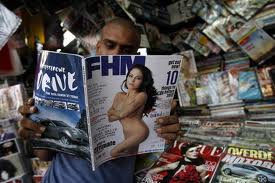
The FHM Cover: Pakistan outraged, but what about us Indians?


Here's one thing I don't understand about the FHM India controversy. Sure, Pakistan is outraged at both Veena Malik's nudity and the ISI tattoo. But what about us Indians? Isn't there any debate in India over this cover and its presence in our horrifyingly repressed Indian society? 
No, I am not a social conservative nor am I bore. Unfortunately, I am an Indian woman who has to navigate her way through the streets of India and doesn’t find it fun. Let your guard down for a minute, and there’s sure to be a random male body part brushing past you. Wear anything remotely provocative, and just the leers will make you run for cover. Even as women on screen and magazine covers compete to shed their clothes to get noticed, I find myself wishing for Harry Potter’s invisibility cloak to walk Mumbai’s streets. 
No, this is not a tirade against the Indian man and his roving hands either. I feel sorry for Indian men. They are amongst the most sexually repressed in the world and it couldn't be fun for them either. It leads to all kinds of perversities, the need to harass women on the streets being one of them.  
Lads magazine have similar covers in the West too. But they exist in a different sexual context: a context where men are not repressed and women know they can walk the streets without feeling violated. These covers merely act as a bit of fun and titillation here. 
But within an Indian context, how exactly should we view such covers, shoots, item numbers and porn stars on Bigg Boss doing pole dance numbers? Whom are they really liberating? Certainly not me, as I stand surrounded by leering men next to a Wheelers at Mumbai's train station with Veena Malik hanging naked above me. And certainly not the Indian man, for all he is getting is another image to take to toilet as he silently jerks-off to it. 
Meanwhile, Malik sues FHM for 100 million rupees, and FHM countersues her for 250 million rupees.

Thursday, March 17, 2011

indiancompass.com: Directing Indians around Europe like no guidebook can


It has been silence on my blog for so long. 

But my life has been noisy, chaotic, busy, exciting and full of challenge. I am no longer jobless, footloose and fancyfree in London. 

No, no. Nobody offered me a job. But I have created one for myself. I am now - Gentlemen and Ladies - the founder and editor of a travel website: indiancompass.com. It’s purpose: To Direct Indians Around Europe Like No Guidebook Can. 

I can say without any doubts that my site - which I started along with a friend and Erasmus-Mundus alumni, Sakshi Ojha ten days ago - is the first site connecting Europe as a holiday destination to Indian tourists in a dedicated way. 

You will roar, Come On! What about Lonely Planet? What about Time Out? What about Conde Nast Traveller? 

And my answer is, what about them? They are not written for Indians. Most guidebooks are written with Australian and American backpackers in mind. Will you ever find a reference to Bollywood, Indian history, vegetarianism, travelling with one’s old parents and most importantly, VISAS in these guidebooks. Nope. Because they don’t “do” Indians in these guidebooks. 

Which leaves us with the LP and CN Traveller magazines. These magazines will help you find destinations to travel to - exotic, far-off, mysterious, seductive, expensive destinations. But they won’t tell you how to deal with the realities of travel: how to get to these destinations, how to book for accommodation smartly, which visas to apply for, how to get the best of Rs--Euro exchange rate, how to get your public transport from the airport to the hotel, where to take taxis and where not, how to make the best of just a day in a new city, how to survive as a vegetarian in meat-dominated countries, and many such details that confuse, harass and worry us through our travels. 

And my experience is that lesser these niggles, the more travel becomes a pleasure. 

So I, along with five experienced Indians who have travelled around Europe, will do the honour.

My venture arises out of my frustration. While publishing in India is growing exponentially, most of it is aspirational, and little of it is arising from within. Yes, it is good to give people aspirations. But you should also give them the necessary tools to achieve those aspirations. My website is that practical, down-to-earth, riddled-in-reality tool. And I am damn proud of it. 

My project has arms, legs and brains. Will it have luck? That will depend on you. 

Visit my site, Indian Compass. Use it, read it, comment on it, criticise it - if you must - and help me make it something useful. 

And if you like it, go to its Facebook Page called Indian Compass, and like it there. 

Site: indiancompass.com
Twitter account: indiancompass
Facebook page: Indian Compass
email address: info@indiancompass.com

Thursday, February 3, 2011

Events in Egypt: Whose revolution is it anyway?

So for the seventh day in a row, all the front news on British newspapers (BBC News, Guardian, The Independent) is dominated by events in Egypt.

I wonder why British newspapers think it is critical for Britons to follow the Egyptian uprising against its dictator so painstakingly, giving it greater importance over anything that is happening in their own country for days on end. 

Mind you, I am not saying that the events are unimportant. They are momentous – but for the Egyptians. Not the Britons. I can understand coverage. I don’t understand coverage in exclusion to everything else. I am sure British people are excited for the Egyptians, and wish them well. But they play no material role in the success or failure of the revolution. That will be up to the Egyptians. And either way, life in Britain will go on as before without people feeling even a speed bump.

Yes, Middle East is strategically important to the West. But that is of greater concern to the governments not the people. The British people accepted the fact that Middle East was run by dictators. It didn’t stop them from going there on exciting holidays or shopping trips. Yes, they disapproved – especially at dinner parties – but accepted it as a reality. Now, as these countries become democracies, they will accept that too, and continue with their holidays.

I don’t think the British people share the rushed, amazed excitement of the journalistic community over the events.

I would put the sustained coverage to two things.

Journalists are excitement-junkies. They need to believe that what they do is exciting and important, and what is more exciting and important than a suppressed majority rising up against their evil dictator. Never mind, that neither comprise their readership.

And second, an empire hangover. Somehow, Britain is unable to accept that the welfare of half of the world is not up to them. They don’t decide the fates of people beyond Britain. That there was a dictatorship in Egypt and Tunisia was not Britain’s doing. That its people rose up against them wasn’t either. It is their history, struggle and victory. British media can cover it, discuss it, explain it – but Britain can’t share it. So get over it!