Showing posts with label Media. Show all posts

Friday, March 16, 2012

Catch 22: Or Why I Can't Finish Reading A Food Review


Guess the taste: raw beef, eggs and potatoes
In my entire life, I have never been able to finish reading a food review. Sorry Naresh, sorry Iain, sorry Guy (the food reviewers that I worked with) - not even yours, not even the ones that I may have joined you for the food to. 
It is not because I don’t care for food. I do. I really do. Bad food upsets me. Bad service upsets me. Bad ambience upsets me. Which is why I was permanently upset in London - the food quality was so poor in general. 
Today, while reading a review in the toilet of a seafood restaurant Dimitri’s by some Mr Michael Harden in the latest Melbourne Weekly, I finally figured out why. 
It is because most of the review is just gibberish to me. 
Here’s a line out of the review. “There will still be the superb spakonita made with wild greens, the semonila-dusted calamari served with auso aioli, French toast made with baklava and the brilliant gigantes - large tomoatoey baked beans served with poached eggs, loukaniko sausages and feta, all examples of the modern Greek approach that owner Jim Karabagias does with intuitive flair.” 
To begin with, I find my comprehension hiccuping four times in that one sentence - at “spakonita”, “auso ailoi”, “gingates” and "loukanikos”. And each time I hiccup, my interest in the review falls a few notches unconsciously. (In all, I hiccuped nine times in the tiny half page review). 
Besides, even when I do recognise all the ingredients I find it tough to imagine them together - French toast made with baklava? Now there are people who can simply put unlikely ingredients together in their minds and conjure up the taste. They are usually contestants in MasterChef. To the rest of us, the words describing the dishes are simply gibberish until we actually taste them. And if we can’t imagine the taste, how will be know that we will like the taste? 
The only time a food review comes to life for me is when something goes wrong with the service - the staff is rude, or the food comes too late or the bill contains an unexpected charge. Because human F-ups are something we all can relate to. 
The problem is that food reviewers want to bring to you interesting new restaurants offering interesting new foods in interesting new ambience. But newer the foods, ingredients and atmosphere, the more I hiccup, and the more I lose interest. 
And that is what I call a Catch 22.

Monday, January 16, 2012

Clarkson goes potty over India: let's be outraged but for reasons other than the HCI's

Here's why I can't agree with High Commission of India, London's, demand that BBC apologises for Top Gear's offensive portrayal of India on their 90-minutes Christmas Special.

If we don't give others the right to make fun of us, we must also give-up the right to make fun of others. And I dearly don't want to lose my right to make fun of the British: their terrible food; their inability to hold down a drink (evident in the all the puke you see on the streets on Saturday and Sunday mornings); the Katie Price-inspired fashion that dominates Picadilly Circus; the quixotic British train system that breaks down at the mere mention of snow, rain or autumn leaves; the famous British bureaucracy and the mad Prince Charles.

Remember, if we don't want the British to laugh at the Top Gear episode, we have no right to laugh at this scene from our own beloved Kabhie Khushi Kabhie Gham.


This, after the British Government so kindly allowed us to shoot half our film in their country!

Besides, here's something I don't get about stereotypes? Is a depiction still a stereotype if it is true?

Ok, so the Top Gear showed street dogs and Indian men pissing on the streets of Mumbai, long queues in front of Railway ticket counters, they talk about tourists in India getting the trots (or diahorrea), the dangerous highway between Delhi and Jaipur. But aren't they true depictions of our lives. I can't remember a single day in my fifteen years in Mumbai (or 22 years in India) when I didn't see street dogs and men pissing in the open. And yes, public toilets in India are a shame. I challenge the High Commissioner of India to England to use the public toilet at Kurla Terminus in Mumbai. These are not generalisations, these are the realities of living in India. It is just that the Top Gear depicts them in their standard cheeky style.

The Top Gear team also showed the lively street stalls and enterprise of Mumbai (in fact, Clarkson and team come sloppy seconds against the dabbawallas), Delhi's glitterati in their incredibly expensive cars and the beauty of the Himalayas.

The show hosts also constantly make fun of Britain. The whole exercise shows the British products as awful and poorly constructed, and themselves as buffoons in the garb of Britain's representatives. And they are happy to make fun of themselves. (In fact, over the years, they have made more fun of Britain than of any other culture, country or people).

If I do have a quibble, it is this. Their's jokes - whether on us or themselves - were so contrived. The Top Gear humour is at its best when it is spontaneous and full of surprise. But over the years, the character of the three hosts has become so fixed and the dynamics between them so predictable, that one can foretell the result of all their pranks before they have played themselves out. That is just bad television.

If we must protest, it is over this. That even with all the chaos, crowds, surprise, and fodder for humour that India provided them: Clarkson, Hammond and May couldn't really give us a genuine moment of spontaneous humour. We deserved better!

Saturday, January 7, 2012

Ek Main Aur Ekk Tu: Or the new-found zaniness of Bollywood's heroines


Oh God! Not another "zany" Bollywood heroine!

It was sort of fun when Kareena played the exuberant, irrepressible, rebellious (read: zany) Geet in Jab We Met in 2007. But the success of that film led to an avalanche of bordering-on-mad heroines, almost all of them coupled with long-suffering but essentially sensible heroes.

  • Think Aditi from Jaane Tu... Ya Jaane Na (2008) who Wikipedia describes as "a highly aggressive, impulsive girl. She abuses. She scratches." In other words, zany. 
  • Think Aaliya (Deepika Padukone) from Break ke Baad (2010). She was loud, unpredictable, smokes, get drunk and is generally impulsive. In other words: zany. 
  • Think Dimple (played by Katrina Kaif) from Mere Brother Ki Dulhan (2011). Again bold, mischievous, impulsive and good at keeping her hero in a permanent state of alarm. What's that word again: yes, zany.
  • And then there was Tanu (Kangana Ranaut) from Tanu Weds Manu (2011) who was practically bordering on psychotic, as far as I am concerned. 

And now, there is Kareena Kapoor in Ek Main Aur Ekk Tu, due to release in February 2012, threatening us with her "zaniness" again if the trailer is anything to go by. 

Apart from extreme loquaciousness and boundless boldness, the heroines' "zaniness" also tends to include smoking and getting dead drunk at some point in the film (give or take a few films). Luckily, our long-suffering hero is always near by to rescue her when she passes out. Rebelliousness doesn't include rescuing yourself, it seems.

Our hero, in contrast, is sensible, responsible and generally good at toeing the line. This, we are supposed to see as repressed. Our heroine's zaninesss, then, is really about releasing the inner Marlboro Man in the hero. So while our hero rescues our heroine from drunken scraps, our heroine rescues him from life itself. (Also for some reason, it is a role Imran Khan is determined to colonise, playing it in four of the five films I mentioned above).

In most parts, I don't mind the zaniness, except in three respects. 

First, why is it that so many rebellious heroines seem to have no careers or jobs. Geet, Aditi, Dimple and finally the horrifying Tanu: none of them showed any interest in gainful employment. They were all just waiting to get married, hoping to bag a guy through their exuberant personality alone. Between Aaliya and Kapoor (in Ek Main...), one wanted to become an actress and the other a hair stylist. Obviously, careers like law, IT, journalism etc are not zany enough.

Second, zaniness and all is fine but I do mind watching smoking as somehow being emblematic of rebelliousness. It is a generally accepted as a harmful and somewhat disgusting habit and is becoming increasingly unfashionable in the West, from where we picked up the notion that it is fashionable in the first place. In fact, I can't remember the last Hollywood Rom-Com, in which the heroine smoked. Do we always have to remain a step behind the West all the time? Can't we just buck the trend for a change. 

Third, after so many films, zaniness is turning into a bore. 

Let's hope, Kareena Kapoor, who started the trend with Jab We Met, will bring it to an end with Ek Main Aur Ekk Tu.

***
Here's a previous blog, I wrote, about the Bollywood heroines: Dil Chahta Hain: Or Where Have All the Bollywood Feminists Disappeared.

Thursday, December 8, 2011

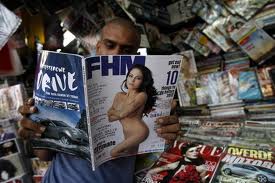
The FHM Cover: Pakistan outraged, but what about us Indians?


Here's one thing I don't understand about the FHM India controversy. Sure, Pakistan is outraged at both Veena Malik's nudity and the ISI tattoo. But what about us Indians? Isn't there any debate in India over this cover and its presence in our horrifyingly repressed Indian society? 
No, I am not a social conservative nor am I bore. Unfortunately, I am an Indian woman who has to navigate her way through the streets of India and doesn’t find it fun. Let your guard down for a minute, and there’s sure to be a random male body part brushing past you. Wear anything remotely provocative, and just the leers will make you run for cover. Even as women on screen and magazine covers compete to shed their clothes to get noticed, I find myself wishing for Harry Potter’s invisibility cloak to walk Mumbai’s streets. 
No, this is not a tirade against the Indian man and his roving hands either. I feel sorry for Indian men. They are amongst the most sexually repressed in the world and it couldn't be fun for them either. It leads to all kinds of perversities, the need to harass women on the streets being one of them.  
Lads magazine have similar covers in the West too. But they exist in a different sexual context: a context where men are not repressed and women know they can walk the streets without feeling violated. These covers merely act as a bit of fun and titillation here. 
But within an Indian context, how exactly should we view such covers, shoots, item numbers and porn stars on Bigg Boss doing pole dance numbers? Whom are they really liberating? Certainly not me, as I stand surrounded by leering men next to a Wheelers at Mumbai's train station with Veena Malik hanging naked above me. And certainly not the Indian man, for all he is getting is another image to take to toilet as he silently jerks-off to it. 
Meanwhile, Malik sues FHM for 100 million rupees, and FHM countersues her for 250 million rupees.

Thursday, February 3, 2011

Events in Egypt: Whose revolution is it anyway?

So for the seventh day in a row, all the front news on British newspapers (BBC News, Guardian, The Independent) is dominated by events in Egypt.

I wonder why British newspapers think it is critical for Britons to follow the Egyptian uprising against its dictator so painstakingly, giving it greater importance over anything that is happening in their own country for days on end. 

Mind you, I am not saying that the events are unimportant. They are momentous – but for the Egyptians. Not the Britons. I can understand coverage. I don’t understand coverage in exclusion to everything else. I am sure British people are excited for the Egyptians, and wish them well. But they play no material role in the success or failure of the revolution. That will be up to the Egyptians. And either way, life in Britain will go on as before without people feeling even a speed bump.

Yes, Middle East is strategically important to the West. But that is of greater concern to the governments not the people. The British people accepted the fact that Middle East was run by dictators. It didn’t stop them from going there on exciting holidays or shopping trips. Yes, they disapproved – especially at dinner parties – but accepted it as a reality. Now, as these countries become democracies, they will accept that too, and continue with their holidays.

I don’t think the British people share the rushed, amazed excitement of the journalistic community over the events.

I would put the sustained coverage to two things.

Journalists are excitement-junkies. They need to believe that what they do is exciting and important, and what is more exciting and important than a suppressed majority rising up against their evil dictator. Never mind, that neither comprise their readership.

And second, an empire hangover. Somehow, Britain is unable to accept that the welfare of half of the world is not up to them. They don’t decide the fates of people beyond Britain. That there was a dictatorship in Egypt and Tunisia was not Britain’s doing. That its people rose up against them wasn’t either. It is their history, struggle and victory. British media can cover it, discuss it, explain it – but Britain can’t share it. So get over it!

Sunday, January 23, 2011

Google: Why despite a tough year, I believe in its longetivity

Google says "I will survive".
Ok, it might sound like tom-toming, but honestly, if others won't acknowledge your cleverness then you have to do it yourself.

Eric Schmidt is stepping down as google's CEO. And here's what The New Yorker has to say on how Google's 2010 year has been: "...Google was becoming defensive. All of their social-network efforts had faltered. Facebook had replaced them as the hot tech company, the place vital engineers wanted to work. Complaints about Google bureaucracy intensified. Governments around the world were lobbing grenades at Google over privacy, copyright, and size issues. The "don’t be evil" brand was getting tarnished, and the founders were restive."

Only, I asked if the same was about-to-happen to Google in December 2009 on this blog. The date was Dec 27, 2009. Now everyone seems to have asking the same question. 

But I think I have moved on. Given all that has happened in 2010 - and yes, I include Facebook's incredible 50 billion dollar valuation in it - I think Google is going to regain its pre-eminent position as a tech company. 

There are two reasons why.

The first is Google's Watch This Space campaign and its efforts to promote online advertising. As I wrote in a blog entry in October last year, Google has figured out that it needs to help the "creatives" to make online advertising an attractive, measurable and exciting opportunity, something that it is not right now. And it has thrown its might behind making that possible.

Only someone who is in the media - jobless like me because print is not selling, and online media is not profitable - knows that everyone needs smart, online advertising to take off. And Google is focussing its energies on convicing advertisers that it is possible.

Already, in the last one year, I have seen several sites move on from ugly banner ads to more attractive, interactive and expandable real media ads - something Google talks-of in its campaign. The clutter seems to be giving way to neater, more navigable sites with attractive, non-intrusive, advertising. See Londonist (which has revamped itself so attractively), or Time Out (which too looks so much neater after its revamp) or Times Crest in India. 

Yes, social media will be the way to go for small businesses. But big businesses - the colas, cars, fashion brands etc - will still need the big platform to attract customers and fight out competition. They will still need advertising and that is where the big, indecent bucks lie. Small businesses may begin with promotion over social media, but at some point they will have to go beyond the friends-of-friends and reach out to the masses in a single sweep. And attractive online advertising will be that platform, and Google is ahead of others in making that happen.

The second reason is Android. Yes, we love the Iphone. Sid & I bought one. But we don't like the way Apple straight jackets you into an Apple personality narrowing your choices to its own software and hardware. We have heard good reviews of Android from our tech friends - it is easy, dependable and most importantly is customisable with different products. Between Sid & myself our second smart phone will probably be the Android. If Sid & I - who are very mainstream buyers - are coming to this conclusion, so must many many others. Sales figures certainly seem to support this prognosis.

I think once Iphone has milked its first mover's advantage, Android will overtake it by simply being a less suffocating buyer to deal with.

And this is why I say: more power to google, my friends. As we say in Hindi: It is a "lambi race ka ghoda" (a horse meant for long races).

Tuesday, January 11, 2011

On Cultural Stereotypes: Immigrant parents, Amy Chua & Jack Straw

I just can’t seem escape Amy Chua and her Chinese mothering tips.

First, my mum-in-law sent me Chua’s essay – Why Chinese Mothers are Superior – published in the WSJ last Saturday, in which she rhapsodised over the benefits of the strict, demanding parenting exercised by immigrant families in America. She credits this parenting style for Chinese (and other immigrant) kids outperforming American kids in general. Then, The Times, yesterday ran an interview with Ms Chua, and today, the Independent, discusses the merits-demerits of Chua’s dictator-style parenting model. And just a few minutes ago, New Yorker uploaded a piece inviting three Chinese-American high-achieving women to give their views on Chua’s assertions.

What I find really interesting is that none of the four articles above mentioned the dreaded words: “cultural-stereotyping”. They discuss the merits and demerits of Chinese-style parenting. But none of them point out that asserting that there is something inherently different about the way a minority community brings up its children – and worse, that the parenting style has definite consequences on how such children will relate to society around them – amounts to stereotyping.

Contrast that with the furious response met to Jack Straw’s statement that young Pakistani men are sexually repressed and are made to think that white women are easy. Thus, they are likely to prey on them. Almost every respectable newspaper in town, and every respectable British-Asian community leader, was discussing the perils of cultural stereotyping even before the merits of Straw’s accusations could be judged.

Why is it that if no one has problems believing that the strict parenting practiced by immigrant parents results in high-achieving immigrant kids, it is unacceptable to suggest the opposite: that if immigrant kids grow up with the notion that white girls are trashy and easy, they may act on that belief. (I don’t have a problem with people picking holes in Straw’s argument – and there are many holes to pick. But I have a problem with the discussion being scuttled under the bogeyman of what “cultural stereotyping” can do to immigrants.)

What the responses to Chua and Straw say to me is that the press and minorities are perfectly fine with stereotypes, provided the stereotypes are positive!

***
Stand-up comedian Russell Peters on another kind of strict immigrant parenting.

Saturday, January 8, 2011

Vogue and our schizophrenic Indian lives

Vogue vagueness
New year, new article by me – this time in the Vogue magazine. It is a profile of the British Indian restaurateur Geetie Singh. Unfortunately, it is not a terribly good article. It seems I had a particularly bad bout of my on-again-off-again sickness COMMAtitis and littered the copy with all sorts of misplaced commas. As for the magazine’s copy editor? Perhaps, he is a fellow sufferer.

So I am really hoping that most women pick up the issue for the same reason that I ever buy the magazine – to look at the ads. I remember my first look at the British edition around the time the buzz around Vogue’s possible entry into India was growing. I was transfixed – but mostly by the advertisements. Beautiful women in the most gorgeous clothes and accessories made by brands I had only ever seen as fakes in India: Donna Karan, Hermes, Chanel, Calvin Klien.

The articles were as visually stunning as the ads and referred pretty much to the same brands – in fact, it was difficult to tell apart the articles from the ads. It rendered a visual consistency to the magazine and converted it into a stunning temple to fashion. So much so, that by the time I turned the last page, even I – a girl so stubbornly proud of her frizzy hair, kurti, and baggy jeans – was feeling a deep yearning to be slim, beautiful and Chanel adorned.

But this is where I find the Indian Vogue diverging from its international counterparts: its incredible paucity of beautiful ads. To begin with, of the 67 full page ads in its latest issue only 3 refer explicitly to clothes – Levis, Monisha Jaisingh and Ritu Kumar. The largest chunk of the ads, 17 to be exact, belong to Indian jewellery stores: the Manubhais, Nothandasses, Gehnas, Shristis etc etc. And no, the ads don’t show smart, modern everyday wear. It is all heavy, traditional, stone-studded, ready-for-wedding wear. Jewellery is followed by watches (9), furnishing (6), skin products (5) and hotels (4). After this it all goes random with whiskey, chocolates, mid-range Australian wine, hairbands, yachts and even realty companies all finding a corner in this Indian temple to fashion.

What makes the magazine experience surreal is that articles and photo shoots – especially, the photo shoots – continue to refer to D&G, Nina Ricci, Christian Louboutins, Roberto Cavalli and gang as if the Nanubhais and Nothandasses never happened. 

To me this gap between the ads and the articles of Vogue says a lot about the wide gap between the reality, pretentions and aspirations of middle class India, and the resulting schizophrenia. We already believe that we are a world superpower without acknowledging the illiteracy, poverty, dirt, pollution and corruption endemic to our lives. Instead, we simply ensconce ourselves in air-conditioned bubbles inside our flats, cars, offices, malls, restaurants, hotels and nightclubs dreaming our rose-tinted dreams of a time when Nina Ricci and Christian Louboutin will be just down the road.

Maybe, that time will arrive. I only hope that the road leading to these stores will not be jammed with traffic, beggars in tatters, dust and pollution.

Saturday, November 27, 2010

Evening Standard vs Talulah Riley: Who's playing whom?

Talulah Riley on the Evening Standard magazine cover
I am not a fan of celebrity magazines. I have nothing against them, only I find my own thoughts and ideas more interesting than anything that celebrities offer, so don’t see the point of reading them. But the one magazine that I can’t quite resist week-on-week is the Evening Standard magazine.

Mostly, I am intrigued by its peculiar criterion for selecting its cover celebrity – she has to be the wife or at least the ex-wife of someone fabulously wealthy and famous. Seldom are these women personalities in their own right. They usually land up saying lots of faintly ridiculous things with a straight face, which is faithfully presented with such extreme seriousness that it makes me suspect mockery. And yet, I can never be sure – which is what keeps me intrigued.

This Friday, it was the turn of 25-year-old Talulah Riley. As an “also appeared” in the films Pride & Prejudice and St Trinian’s, she was on her way to become a footnote to starlet history. Luckily, she caught the fancy of billionaire Elon Musk – the founder of PayPal and now space entrepreneur – who wooed her for a whole of 12 days until she agreed to become his second wife. His billions came with 5 boys [in a set of twins and triplets] from his previous marriage.

I felt quite sure that the journalist, Ms Hermoine Eyre, was mocking her, when she quoted Ms Riley saying:

On her husband’s space exploration projects --“I’d love to get involved with designing habitat systems on Mars – like housekeeping on a grand scale.”

On Musk and his five boys – “When I was little girl I told everyone I would marry a very clever scientist and have ten children. I would always draw the children and they included twin boys whom I named Theodore and Fredrick, Teddy and Freddy for short. It became a family joke, but.. Griffin and Xavier are those blonde-haired twins.”

On meeting Musk for the first time – “There he was, smiling this very big smile and talking about colonising Mars. I was already interested in that kind of thing – the Goldilocks zone of habitable planets and so forth.”

On how she told her father about Mr Musk – “Daddy, I’ve met the most amazing man who makes rockets.”

On her virginity until she met Musk – “I’ve never slept with anyone apart from Elon, which is nice. I mean, which is great.”

About herself – “I am very shy. I don’t drink. I had a gulp of alcohol once and it was disgusting – so bitter. I don’t drink tea or coffee. I’m like a child, I like fruit juices and sodas and creamy hot chocolate.”

Of Elon’s buddies, Facebook creator Zuckerberg and Google creators Larry Page and Sergey Brin.– They are “good people, doing good things... which is comforting, seeing as they could create an artificial intelligence to destroy us all.”

Why would Ms Eyre pick these exact quotes except to present Ms Riley in her full, glorious dumbness?

But then I start suspecting that she is actually buying into Ms Riley’s ridiculous Princess Di-meets-Marie Curie self-image, when she writes:

‘She [Ms Riley] rarely had boyfriends and was more interested in quantum mechanics. So in order to get a grounding in Newtonian physics, she was studying in her spare time at the Open University.’ [err… quantum mechanics is what people do their Phd in and Newtonian physics is what we study in eight grade in high school. Doesn’t Ms Eyre recognise the difference?].

Or

I remember meeting her on the red carpet a few times at this point in her life [her pre-Mrs Talulah Musk days], and she always came across as withdrawn, but poised and perceptive.’

‘Throughout our interview, Talulah exudes calm happiness, not showing-off so much as simply pointing out her spouse’s qualities.’

‘Talulah, I am sure, holds her own [before Musk]. Last Christmas, just to tease him, she filled his stocking with coal.’

Who is playing whom? Is it that Talulah Riley recognises Ms Eyre for an idiot and is feeding her with all kinds of rubbish? Or does Mr Eyre recognise Ms Riley for a dumb blonde and is playing her along? Or is it that they are both idiots taking each other on face value?

Such a Freudian intrigue – how can I resist it?

Wednesday, November 24, 2010

FT, Martin Parr and whether ex-Mumbaikars suffer from post-traumatic stress syndrome

I finally got around to reading the FT Weekend Magazine on my way back from Paris.

The tantalising cover and the bold “Seven Days in South Asia” had me most excited. I mean, how often do you see a North Indian woman in a violent pink sari and comic sunglasses on the cover of FT?

Unfortunately, the story was a let-down. It was written in the style of a diary of the FT editor Lionel Barber about his weeklong trip to India and Pakistan. During the eight days – yes, it was eight days but I guess, “Seven days in South Asia” just sounds better – he essentially hobnobbed with the rich and the powerful of the two countries starting with the governor of West Bengal, followed by Mamata Bannerjee, Mukesh Amabani, Anil Ambani, Anil Agarwal of Vedanta Group, Ananda Mahindra, Ratan Tata, PRS Oberoi of Oberoi Hotel, the Ruias, Jyotiraditya Scindia, Manmohan Singh, the governor of Punjab Salman Taseer, and finally Asif Ali Zardari. As all these interviews had to be reduced to a four page story, what we get is mostly his impressions and a few quotes to support those impressions. All that is fine by me. But why the comic, cheeky cover image which suggested insights into the self-perceptions of ordinary Indians? To me, the cover seemed disingenuous and misleading.

The image was shot by Martin Parr. Chirodeep, a photojournalist friend of mine, had first told me about him. Then in a space of a week, I found myself gazing at this works twice. First on the FT cover, and then again at an exhibition at Maison Européenne de la Photographie, which was a part of a month-long photography festival in Paris. Parr’s photographs at the exhibition were from one of his early acclaimed series published in 1986 about British tourists holidaying at Brighton.

The exhibition was about extreme photography: or images that pushed either the photographer or the audience to the extremes of their physical, social, imaginative and/or emotional abilities, and how just by doing so, made the experience a little bit mundane.

Which is why this image by Gabriele Basilico stayed with me for long after I had left the exhibition. It caught my eye the moment I entered the room, mostly because from a distance it looked like Mumbai to me. A densely packed neighbourhood with mid-rise buildings in a semi-ruinous state, where else could it be? It turned out to be shots of bombed-out Beirut from 1991. But honestly, even at a closer look, it kind of looked like Mumbai on an ordinary day to me. It was appalling to think that we Mumbaikars live in what most people would consider “extreme conditions” on an everyday basis.

But don’t extreme conditions come with some form of associated trauma? Which makes me wonder whether I am suffering from post-traumatic stress syndrome, now that I am not living in Mumbai anymore?

What would its symptoms be? If I had to guess, they would be:
A)    A rush of joy at the sound of traffic noise
B)    Tap water-related paranoia
C)    Morbid fear of silence
D)    And a constant bursting into happy tears at the sight of crowds

If you have any other suggestions, feel free to leave to use the comment space.


Sunday, November 21, 2010

A discourse on prejudice: Or why I love coming to Paris.

What I love most about being in Paris is that I can’t understand a word of what anyone is saying. So everyone sounds intelligent and educated to me. Besides, how stupid can they be – they SPEAK French!

In England, I can eavesdrop and am constantly reminded of the general pettiness of human race. Because really, all that people ever do is complain and bitch. Like the two ladies who sat next to Sid & I in the Eurostar to Paris. Three hours! For three hours, all they did was bitch about people, including ironically the girl for whose hen’s party they were visiting Paris.

Worse, in England I can detect accents. And it gives me a sense of people’s background and education – if not of their intelligence. I try, I really try not to judge them on the basis of it. But despite my best efforts, if someone sounds like Katie Price aka Jordan, it is likely to be a short acquaintance. Because I have only limited social time and I would rather spend it with people with whom my wavelengths have at least half-a-chance to match.

In India, the instant judgements go much further because I know the society so much better. Accents aren’t the only giveaway to people’s histories there. In India, I can guess a person’s caste, community and culture by his or her very name. Add an address and occupation to that, and a person’s whole life is reasonably mapped out before me without any effort on my part.

Of course, every now and then I am proved wrong. But it is not pleasing to start an acquaintance under the burden of prejudice.

As a student of media, I know that stereotyping people is wrong. We should not slot people on the basis of their colour, ethnicity, culture, community, caste, accent or education. Because over and above all they are individuals, and their shared cultural experiences will always be modified by their own unique personalities. But how do I train my brain to filter out people’s colour, names, accents and addresses and begin every acquaintance with a clean slate. It just refuses to listen to me.

So instead, I live with guilt: the guilt of a good, Labour-supporting liberal.

And occasionally, I escape to Paris where I can always assume the best of everyone.


***
The Scottish comedia Danny Bhoy on French accents

Wednesday, November 17, 2010

London's Most Expensive: Or why I love and hate online journalism

What I love and hate about the internet and online journalism is the power it places in the hands of the readers.

I love it because sometimes the commentary by readers opens your eyes to the most curious ideas – ideas that that would have never occured to you. For example, when I wrote a blog about how Frieda Pinto is a fairly average-looking girl in India, I practically got assaulted by an American fan of hers in the commentary section. Her argument was that Pinto wasn’t Indian at all, but Latina, and that Indians in general were ugly and racist and hated Pinto.

Ok, so her language offensive. But I had never thought of Pinto as Latina-looking. But damn it, she is. I can see her playing Latina roles – if her acting chops are up to it – and make a successful Hollywood career out of it. But for the trenchant reader, I would have never thought of it.

But I hate it when readers point out factual errors in your story. For example, I recently wrote an article for the website Londonist on some of London’s most expensive experiences. One of them was London’s most expensive whiskey, and my research led me to a £740 double measure of whiskey at Albannach Bar at Trafalgar Square. My conclusion was based on other media reports, personal memory and internet research. And I thought how could one possibly trump £740 for a shot of whiskey?

Only, as one reader pointed out, Dorchester can. It offers a “Macallan 57 years in Lalique Crystal” for £870.

Thankfully, we were clever enough to put a rider at the end of the story asking readers to trump our finds. So we had already put the humble idea out there that our finds may not be the full and final truth.

Still, I hate being trumped. But as most literature on the future of journalism suggests, I should just get used to it.

***
Here's a little clip from Drop the Dead Donkey - a satirical series on journalism from its good ol' days in the '80s. Can you imagine any journalist getting away with it today!

Friday, October 29, 2010

Baby gorilla at London Zoo: Or is it EastEnders in a new avatar?

Hmm... so I have started contributing to Londonist. It is all a big experiment and all shall be revealed in due time.

In the meantime, enjoy my latest contribution on gorillas, zoos and EastEnders.

Thursday, October 28, 2010

i Spy: or what possessed The Independent to launch another newspaper?


 Why oh why, did The Independent launch i?

It is a question that has me befuddled ever since I read the first copy of this tabloid-sized newspaper that launched two days ago – the first national newspaper to be launched in Britain in 25 years. I actually read the paper for three days running to try and figure that out.

It is not that I don’t think there is a need for a newspaper, a proper paper publication at that, in the UK. The endlessness of news over the web – the twitter feeds, facebook updates, rss feeds, google news updates and reams and reams of endless commentary – does make me wish for a one-stop shop every morning for all the important events of the day past.

But I wanted it be real news – facts and information that would clue me into the important issues surrounding my life. I didn’t want to be entertained. I didn’t want gossip. I didn’t want lifestyle features. And I certainly didn’t want views and commentary telling me what to think about the issues at hand. I have enough media at my fingertips to do just that for FREE. I only wanted facts – the bare bones to build my own opinion on, if I cared enough about the issue.

That is exactly what i claimed it would do. It was supposed to be “a new kind of a paper” giving you your “essential daily briefing” that “cuts through this information overload to give you all you need”. Only it came filled with features like “Are you getting your oats?”, “best toys in town”, “10 best leggings” reviews on films, theatre and books, tv listings, and still more commentaries and views on television, arts, business, sports and politics to add to the existing media cacophony.

But it is only 20p, The Independent says. The point is I would still have to take a detour to a newsstand or at the very least, stop by a streetside vendor, search through my handbag, and extract 20p for the pleasure. For that much effort, wouldn’t I want to treat myself to a real newspaper?

Sunday, October 17, 2010

Watch this space: Or has Google come to our rescue... finally?

Zuckerberg: Poor little rich boy
Watching The Social Network yesterday got me curious about how Facebook makes money. After all, the site hasn’t made a public-offer yet, it hasn’t been bought out, so how has it made Zuckerberg the youngest billionaire in the world?

The answer left me reeling. It made $500 million dollars last year primarily through advertising. Ever noticed those four small boxes that pop-up on the side of your profile page? I hadn’t. I would have, if I had known that they were making nearly $450 million dollars for Zuckerberg & Co annually. And what made me nearly burst into tears was that the rest of the $50 million dollars were being made through sale of virtual goods – those silly $1 ducks, mugs, hugs and batches we keep sending to each other.

How is it that Facebook can get people to collectively spend $50 million dollars on silly goods that are not even real but newspaper and magazine websites can’t get a penny out of people for bringing critical information to their desktops every day? What is it that media companies providing information content don't seem to understand about their audience? Or is it that they are just lazy, uncreative and incapable of thinking of innovative ways to squeeze money out their audience? The best great minds such as Rupert Murdoch’s have been able to come up with is a militant, view-on-subscription-only paywall approach. But if I haven’t felt motivated enough to get an online subscription to his Sunday Times then fat chance Mr Murdoch has with ADD-infected teenagers? 

But help may be on its way if Google’s Watch This Space campaign is even half as effective as it sounds.

Now we might as well accept that information content is all going to go digital. It is also mostly going to be free. So the only saviour content creators can possibly find is advertisors. And yet, online advertising has always been particularly dull. Those tacky banner ads have a tendency to pop-up at the wrong time and wrong place. Besides, conventional wisdom suggests that the medium is too fragmented and fractured for any campaign to make any measurable impact. However, Google has put its geek-might behind making online advertisements easy, smarter, attractive, measurable, customised and better-targeted than ever before.

Algorithm-by-algorithm, Google is trying to streamline the online digital space to make it easier for advertisers to find the right audience, place smart and attractive advertising campaign swiftly and smartly, and be able to measure its success more accurately.


For example, Google representatives Barry Salzman and Neil Mohan at the Interactive Advertising Bureau’s Mixx conference last month (see video above) predicted that almost half of all online display ads will move from static text banners to real media ads, that is, videos which are interactive and expandable. Google claims to have the necessary technology called the double click studio to help the conversion. The ads will be customised in real time depending on the audience and their location. They are also working on more metrics to examine the success of the campaign, which hitherto has been dependent on the actual number of clicks on display ads. But clicks didn’t take into account people who made related searches or visited the product’s website instead of clicking on the display ad. Google claims it can make that possible in the future, apart from coming up with other solutions to measure a campaign’s success.

If Google can, and if online media becomes genuinely profitable for the first time, perhaps there will be some hope for me.

And yes, The Social Network was a fabulous film! Zuckerberg was a sneaky little bastard but what a rich sneaky little bastard he was.

Friday, October 8, 2010

Zuckerberg & The Social Network: Or why when in doubt I turn to The New Yorker


On my third day at Time Out Mumbai, I dragged Naresh into our merry, cherry-red office meeting room and demanded to know what he expected of me as a journalist. I was an aggressive, green 24-year-old, and was determined that my Columbia-educated, WSJ-alumnus editor, Naresh Fernandes, was going to teach me all that there was to learn about journalism. Naresh, in his usual part-alarmed, part-taciturn way, asked me if I had heard of The New Yorker. I hadn’t – you see, I was also a stupid 24-year-old. He went ack to his desk, got a few copies, handed them to me, and said: “This was my favourite magazine in New York. This is what I want Time Out to be.”

I remember feeling a bit deflated at that time. But six years later, I wonder if he could have taught me more about journalism then to introduce me to the absolute best in the trade. I am a complete, unabashed, unapologetic fan of the publication and now website. I love it because whenever there are too many voices, too much emotion, too much hyperbole in the air about something, I know I can turn to The New Yorker for a detailed, thoroughly well-researched and reasoned analysis of the situation.

And if there is one subject that has tongues wagging at the moment, it is David Fincher & Alan Sorkin’s film The Social Network, which is the story of how Mark Zuckerberg, the creator of Facebook, screwed all and sundry in the process of becoming the hippest geek in the world. It is hardly surprising that the film is so anticipated. After all, no internet tool since Google had impacted our lives as much online as offline. For better or worse, it tapped somewhere deep into our psychology and affected our notions of friendship, popularity, self-awareness, privacy and connectivity. And of its reach, I can only say that my 61-year-old Dad who still types with one finger has a Facebook account, as do many of his friends.

The film will release in the UK on Oct 15 but if reviews of the film from the US are anything to go by, Zuckerberg is depicted as a socially-retarded, sexually-charged, and morally-vacant person. The film is not kind to Zuckerberg’s personality, his intentions or the way he went about making the Facebook tool. In short, we will probably come out the theatre heartily disliking the fellow and suspicious of how his intentions for us, the unquestioning users of Facebook.

But trust the New Yorker to come out with a more questioning and nuanced profile of Zuckerberg just before the film’s release in the States to balance the Sorkin’s hyperbolic character. The author Jose Antonio Vargas still describes him as supremely ambitious, iconoclastic and socially-retarded, but tempers his portrayal with enough humanity to make him believable. There are four things from the article that I would like to keep in mind when I watch the film.

a)    He was 19 when he created the tool. He is 28 years old now. Surely, some self-reflection must have accompanied his ascent into adulthood.

b)    If money and acceptance was all-important to him, why didn’t he sell his tool to Yahoo!, Microsoft or MTV Networks, all of whom offered him between 75 million dollars and a billion dollars for the tool.

c)    His girlfriend of last seven years, Priscillia Chan, is a Chinese-American studying medicine at the University of California. Somehow that does not sound like the actions of a horny, misogynistic jerk – that the film supposedly shows he to be – who suddenly came into a lot of money and fame.

d)    And finally, the fact that the 49-year-old Sorkin admitted in the article that he knew very little about social networking and professed an “extreme dislike of the blogosphere and social media”. Are the most ignorant, often the most prejudiced?

The New Yorker article was important because how we view Zuckerberg, and perhaps Facebook, will be affected by the film for a long time to come. Hence, I am glad that there is another compelling and alternative account of him out there too to counter the film’s character. After all, as any good journalist knows, you will never know the truth but it is important to put all versions of it out there. And The New Yorker is all about good journalism.

Thursday, September 9, 2010

The rise and rise of Mayank Shekhar: Or has Sarah Palin found her literary match?

To
Mayank  Shekhar
National Cultural Editor and Chief Film Reviewer
Hindustan Times
India

Dear Mayank,

In the Wikipedia entry for Peepli Live – one of the most talked of Hindi films of late – I came across an extract from a review of the film by you: “The satire is irresistible; the subtext, compelling. And yet neither shows itself up in any form of self-seriousness. The comic writing is immaculately inspired”.

Mayank spreading knowledge - hopefully not on English
And I found myself wondering, what exactly is “self-serious”?

Perhaps, what you mean is serious.

Only, as I understand a good satire is something superficially funny but with a serious subtext. If it doesn’t have a serious subtext, then it is just a comedy not a satire. So what exactly do you mean when you say that the satire and subtext are both good, but thankfully not serious?

And what exactly is “immaculately inspired”? Now, I’ve heard of immaculate conception, but immaculate inspiration? I am still trying to figure that one out.

Now, I bear you no malice – after all, you are my Facebook friend, a friend of a friend, and best friend of a best friend, and we did have a hazy, boozy conversation at a literature festival in Mumbai several years ago. But this is what I don’t get about your rise and rise: How can you be one of the most popular film reviewers of India, the national cultural editor of one of the country’s largest selling dailies, and a winner of the Ramnath Goenka Award for Excellence in Journalism – when you have no concept of the English language, your primary tool of trade?

For example, here is what I don’t get about your review of another recent film, We Are Family:

The review begins with: “It’s this thing about soppy chick flicks, or afternoon soppy soap operas, if you will. The male character is destined to severe step-mom treatment. If he’s present at all, he usually has no say in his own destiny.” Err.. perhaps what you meant was “severe stepson treatment”. Step moms are usually disturbingly in control of the destinies of others.

“The setting is the sanitised First World. Spaghetti's ready for supper. Aesthetics of modern, good housekeeping is established.” What exactly is “spaghetti’s ready for supper” hanging around for unless it is a quote from the film, in which case shouldn’t it be placed within quotes?

“It’s just the idea that binds all these together, which is entirely outsourced from the West.” No, no Mayank, what you mean is “entirely borrowed from the West” because you cannot outsource from, you can only outsource to.

“A warm, doting single mother, losing before her eyes, her life and her sweet children to fatal cancer, you can tell, is something that’ll weep any woman off her feet.” Only Mayank, in the film the mother is not losing her kids to cancer, the kids are losing their mother to cancer.

And you don’t “weep women off their feet”, you “sweep them off their feet”. Or were you punning? It is so difficult to tell.

“This cultivated suaveness is but suddenly forgone as everybody begins to simultaneously weep from the screen.” 

Now Mayank, I am trying very hard – very hard indeed – to imagine them “weeping from the screen”, but it is very difficult, let me tell you.

And then there are the mysteries of your review of another film Kites:

Your review begins with: “Two people (Hrithik Roshan, Barbara Mori), respectively romance another from the same family (Kangana Ranaut, Nicholas Brown), purely for the love of the money. The girl’s an illegal immigrant into the US from Mexico. The boy is the American half of various green card marriages on sale: “$1,000; honeymoon charges extra.””

Now, I’ll forget the messiness of a phrase like, “American half of various green card marriages on sale”. Let’s start with the basics - which girl and which boy? I mean, is Moli the illegal immigrant or Kangana Ranaut? Is Roshan the one half of the various green card marriages or Brown? I am confused.

“The premise from hereon could take the shape of a slight comedy of deceit (Woody Allen’s Matchpoint), or follow an aggressive drama (Anthony Minghella's The Talented Mr Ripley).”

A “premise” does not have continuity, Mayank, so it cannot not take shape or follow. I think, the word you were looking for was simply “story” because a story can take shape.

“The said Mafiosi home belongs to one, Bob Grover (Kabir Bedi), the “owner of one of the biggest casinos in Vegas,” no less. Senators, governors etc swim under Bob’s pant pockets”.

I won’t quibble over the fact that there should be no comma following “one” because I am too busy trying to imagine people swimming under pockets. Only, I can’t. What do you mean?

“No Hindi film actor ever, I suspect, has worked himself up this much to make the super-star grade.” No, no Mayank, what you mean is “worked on himself”. “Worked himself up” means gotten himself excited.

“Hrithik remains the perfect foil for an action piece across the barrenness of Nevada.” No, no – “foil” means “to frustrate” or “defeat”. What you want to say is “perfect … “perfect… I don’t know. I don’t know what you want to say.

And Mayank, these are only two reviews. And I have not yet mentioned all your mixed tenses, misplaced commas and crazy syntax. You would be such an inspiration to Sarah Palin.

But come every Friday, I'll carry on with my helpful advice on your language bloopers.

Or else, I will be happy to pass on the numbers of some good English language tutors. After all, you are my Facebook friend, friend of a friend, and a best friend of a best friend. And what else are friends for?

Yours
Always ready to help
Chetna Prakash (nee Mahadik)

Thursday, August 19, 2010

The Foto8 Summershow 2010: Or why I'd give Poulomi's exhibition a go

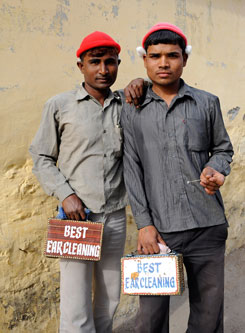
Best Ear Cleaners by Nick Cunard
Poulomi messaged excitedly on Tuesday. Her photo was being displayed at the foto8 summershow exhibition at the Host Gallery, and she wanted me to come for the opening. “There’ll be wine, canapés and lots of industry people,” she said by way of enticement. I didn’t go. Because Sid came back home looking rather miserable, and I didn’t want to leave him alone to noodle soup and bbc iplayer. (What to do? I like Sid, he’s nice to me.)

But l am also a loyal friend so I diligently registered my footprints at the exhibition the next day.

What took me by surprise was that 15 of the 153 works of photojournalism on display were shot in India – meandering between Kashmir, Rishikesh, Varanasi, Bhopal, Rajasthan, Ahemdabad, Jharkhand, Mumbai and Goa. No, no, they were not shot by Indians, silly heads, only shot in India. There was only one photograph actually taken by an Indian, and the honour went to my friend, Ms Basu (pronounced Boshoo, thank you.)

Now, I dislike whining postcolonialists enough to agree that yes anyone – Indian or otherwise – has the right to come to India, take our pictures, and display them in London galleries. And they should be allowed to shoot what they think is interesting, and celebrate it as such. What I was interested in was what I, as an Indian in a London viewing these images, should get from them? Do they observe and single-out things that I as an Indian – born and bred in India – do not or cannot notice myself?

The first image of India that caught my eye was of the ear cleaners of Rishikesh? Oh no, I thought. Aesthetics aside, haven't I seen ear cleaners being shot and documented (as a lovely, quirky anachronism) by other Indian photographers already?

Next came the train ride. Ok, nice enough shot but as social documents go the great Indian railway journey is a bit overdone, I think.

The three shots of Bhopal Gas Victims. Well, at least it keeps a controversial, unresolved issue in the limelight.

I began to get intrigued when I found myself face-to-face with a black-and-white close-up of a school girl from Varanasi – her face tightly framed by her ungainly woollen scarf. Shot by Kathryn Obermaier, the portrait reminded me of how I used to dress with no sense of fashion whatsoever when going to school – hair tied in tight plaits, red ribbons, long skirts, long socks, oily hair, tight woollen scarf and a deadly scowl. If I looked anything like her than I was absolutely lovely in my unassuming ugliness. I’m glad such innocence lives on.
Courtesy: Poulomi Basu

Poulomi’s photograph of the women of the Indian Border Armed Forces as they trained before being deployed to the line of control between India and Pakistan stood out too. Who would know, if it wasn’t for Poulomi, that such a battalion exists. Yes, a battalion of women soldiers in a country where women are still being burnt alive for dowry! Nice contradiction, isn’t it? I couldn’t help but wonder what went through those bodies and minds, and Poulomi’s image gave a glimpse.

I also loved Helen Rimmel’s portrait of Azim Tuman, the chairman of the houseboat association in Kashmir. Houseboat Association? Houseboats? I can’t remember the last time, I thought of beautiful things when someone mentioned Kashmir. And yet, the remnants of those old, beautiful, half-happy things perhaps lay scattered all over the valley and pop-up in photographs like this one.

The others included images of illegal mine workers in Jharkhand (that cesspit of India), ganges (a bit ho-hum), and a couple of intriguing shots by Shiho Kito.

So shot by Indians or not, I'd say the exhibition does give an intriguing glimpse into India.

***
The exhibition will be on till September 4 at Host Gallery, 1-5 Honduras Street, London EC1Y OTH.

Thursday, August 12, 2010

Bring on the Biryani: Or how I saw journalism get its mojo back

Inside the toilets of Dishoom
I have never really believed in the power of journalism. Of course, I had heard of Bob Woodward and Carl Bernstein and had even dutifully watched All the President’s Men during university years, but five years of working as a journalist cured me of the notion that anything I wrote changed the world by even one-tenth of a percentage point.

My cynicism was cemented by the fact that Nandini – the film critic of Time Out Mumbai – would keep sending me to review Hindi films. They would invariably be terrible, I would invariably say so in my reviews, and they would invariably go on to become major hits.  Alright, so film reviews weren’t exactly in league with investigating the president, but if I couldn’t even get people to change their taste in films, how was to convince them to change their leaders.

So I entered my thirtieth year of life convinced of my own powerlessness. And then, Guy Dimond and Dishoom happened.

Now Guy is the food critic of Time Out London, and Dishoom is a new restaurant on Long Acre Road which claimed to be on the lines of a Bombay Irani Café. Last month, while I was doing an internship there, Guy asked me to accompany him for the restaurant review hoping that my Bombay days would come in handy in affirming his views on the place. We sat, ate and concluded that the Berry Chicken Biryani – the signature dish of most Irani cafes in Mumbai – was too dry, and really that ought not to be so. Then he wrote the same in his review, and we all forgot about it.

So imagine my surprise last week, when I was there with a few friends, and we found the whole recipe to be changed. When I quizzed the manager about it, here’s what he said: “some reviews said that the biryani was too dry, so we decided to change the recipe!”

Change the recipe? Change it because of a review? A review that I was – in whatever small measure – a part?

If I could get a restaurant to change its recipe, perhaps, I could change people’s tastes in films. Perhaps, I can change people’s minds about their leaders. Perhaps, I could change the world.

I am ready. Now, if only someone would hire me to start upon the project.

***
With its Biryani fixed, I would consider Dishoom a very welcome and much needed-addition to Central London. It has a contemporary décor, a cool vibe, an eclectic menu (with no Chicken Tikka Masala in sight), and reasonable prices (if you consider about £30-35-for-dinner & drinks-for-two reasonable). No longer will I have to go all the way to Southall or Wembley and suffer the terrible restaurant décors in order to enjoy a good Indian meal with friends.

Monday, May 3, 2010

View the review

Ever since I stepped out of India, I have been terrified of all that I don’t know. Should I express an opinion on anything – be it film, theatre, music, dance, television or even street culture – when I haven’t had a lifelong engagement with them? On so many occasions, I have abandoned blogs half-way, conscious that I don’t have enough background on the subject.

But now I find that the esteemed London reviewers don’t share the same diffidence when it comes to opining confidently on Indian culture.

Last week, I attended the dance performance by Akram Khan and raved about my experience on this blog. Most London reviewers did the same too, in their respective columns, with one crucial difference: most got the storyline hopelessly and hilariously mixed-up.


As the leaflet given to us during the show made clear, the performance was about the relationship between Gandhari and Duryodhana, the mother-son duo from the Hindu epic Mahabharata. In the third, fourth and fifth act, Akram Khan plays Duryodhana and Yoshie Sunahata, the Japanese dancer/drummer/singer, plays his blindfolded mother Queen Gandhari. The relationship is made still more evident from the fact that at one point, Khan is dancing around Sunahata, who stands at the centre of the stage blindfolded with a stick, with the vocals “Maa Sun (mother listen)” echoing through the hall.

And yet, Times online married the two-off, by claiming that Khan played the king, presumably Dhritrashtra, and Sunahata the Queen. Guardian did the same, making the further claim, that the dance was a “portrait of a marriage”. Telegraph claimed that Khan plays the last surviving Kaurava son Duryodhana, and Sunahata the blind king, thereby doing away with Gandhari in a single swoop. The theatre newspaper Stage was a bit cleverer, and refused to commit itself to who was who in the play, focussing instead on the dance moves.

The confident tone assumed by most reviewers, especially Judith Mackrell of Guardian, had me simultaneously despairing and doubling up with laughter. And what about the dishonesty? After all, if they didn’t get the plot, it says something of the performance as well. If the show couldn’t get through to the reviewers, what are the chances of the rest of the audience following the story?

Only Times Online was honest enough to admit that he found the performance a tad confusing.That would have been enough for me to become a follower of Times Online reviews if I hadn't discovered yesterday, that the website has been claiming all over the internet that the Bollywood movie Teen Patti (or three cards in Hindi) refers to three husbands.