Thursday, January 5, 2012

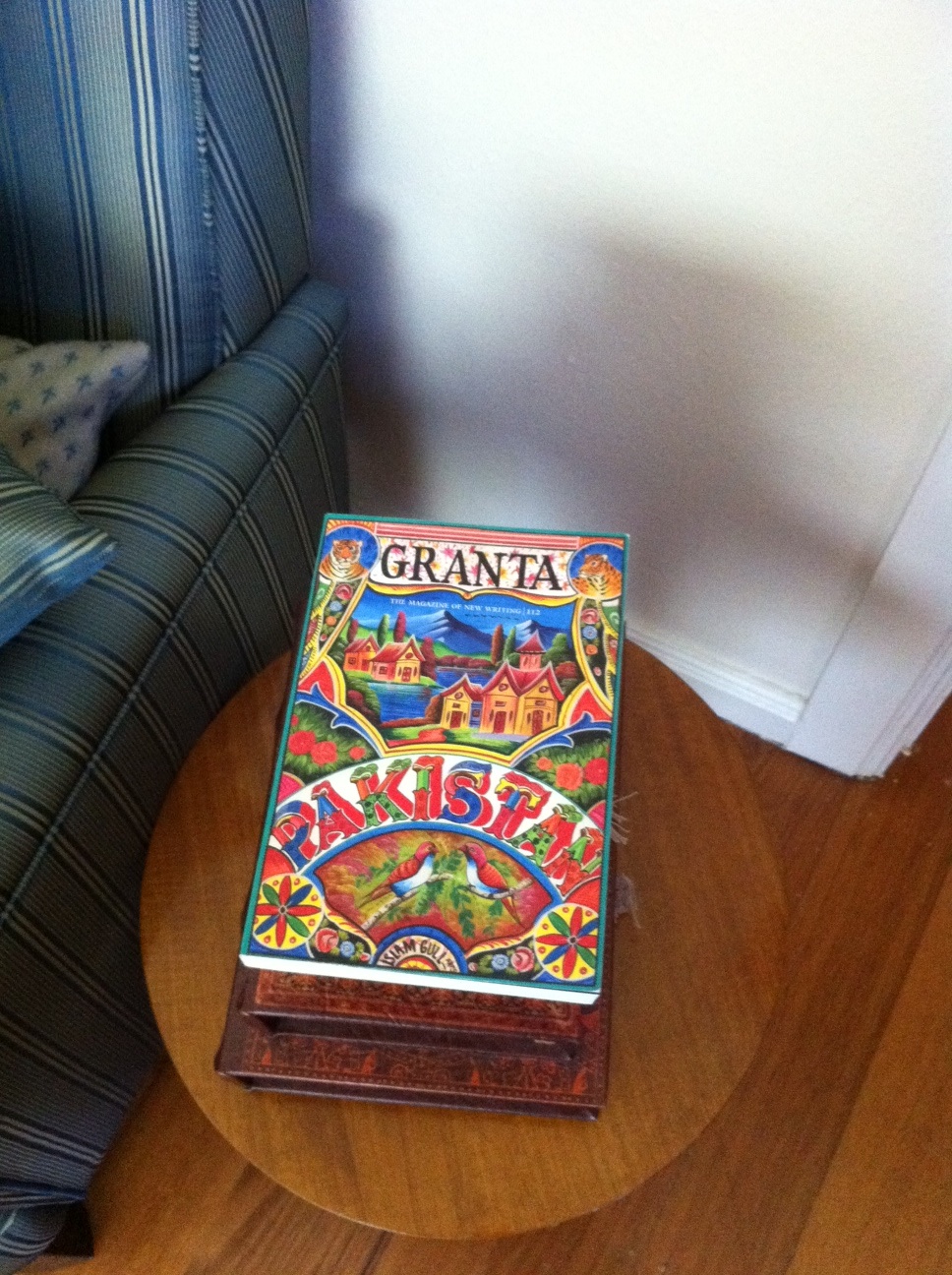
Granta 112: Pakistan - or does Pakistan have a literary scene?

Voices from Pakistan
Reading the Granta Publication on Pakistan - a collection of fiction and non-fiction works by Pakistani writers - I was reminded of an event on Pakistani literature I attended a couple of years ago. It was a talk at the Asia Society in London with three new rising literary stars from Pakistan: Nadeem Aslam, Kamila Shamsie and Daniyal Mueenuddin.

At one point, the moderator commented on the recent rise of the Pakistani literary scene. The garrulous Ms Shamsie pounced excitedly on the subject stating how and why it was Pakistani-English writers' time in the sun. After she had gabbed on for a while, Mueenuddin, who had been remarkably taciturn throughout the evening, suddenly quipped that to say Pakistan had a literary "scene" was an exaggeration. If it existed, he certainly hadn't come across it. The room erupted into embarrassed titters and Ms Shamsie looked decidedly put-out.

After reading the Granta collection, I am inclined to agree with Mueenuddin.

The first sign of a lack of a vibrant literary scene is that all the three above-mentioned rising stars appear again in the collection. Obviously, the editor of the collection wasn't exactly spoilt for choice.

But more curious is the strange uniformity of voice that emerges from the collection. Barring two pieces - Leila in the Wilderness by the British-Pakistani Nadeem Aslam and Butt and Bhatti by Mohammed Hanif - the rest seem so stridently liberal. Don't get me wrong. I have no sympathy for fundamentalists. But how can all the writing arising out of a country so steeply diving towards fundamentalism sound so confidently, one-sidedly liberal?

Of course, the writers acknowledge that Pakistan is the gripped by a violent Islamization movement. But they can clearly see whose fault it is: Zia, America, Jinnah, military and ISI. And they can clearly see who all are affected by it: everyone. But how have the writers remained untouched by the phenomenon? Are they untouched by it? It is the absence of the voices from the middle that strikes me as strange.

Could the uniformity of voices be a result of the rather similar background of all the writers? Either, they moved to Britain or the US early on in life (Nadeem Aslam, Sarfraz Mansoor) or they all seem to belong to the incredibly privileged Pakistani elite. Ms Shamsie writes of visiting her cousins in London every summer and Aamer Hussein of spending childhood summers at Hyde Park. Daniyal Mueenuddin's family still owns huge farmlands in Pakistan. And Fatima Bhutto, well we all know where she stands in the Pakistani social hierarchy. Almost all of them have had long exposure to Western universities and cultures.

How representative are they of the culture they write about? Moreover, do the writers in such a collection need to come from diverse backgrounds?

Either way, writers with very similar backgrounds and attitudes becoming representative of the country's literature reek more of a clique than a literary scene. Of course, if you are inside the clique, it often appears like a scene to you, which may explain Ms Shamsie's enthusiasm.

***
Here's an interview with Daniyal Mueenuddin in which is comments on how most of his peers do not have access to rural Pakistan, where his own stories are set. Perhaps, that is why he holds different views on the existence/non-existence of a Pakistani literary scene.

Wednesday, January 4, 2012

Don 2 or MI4: Which is a more Indian experience?

Last night, in a bid to introduce Sid and my very-soon-to-pop-out baby to some Indian culture, we went to watch the super slick Don 2: The King is Back.  Unfortunately, culturally and aesthetically the film was so derivative of Hollywood that we would have been better-off watching MI4: Ghost Protocol, the twenty minutes-climax of which is set in squalid Mumbai and even features one of its famous traffic jams.

The film reminded me of a corny dialogue from a late-80s Bollywood-starrer Jamai Raja. It had Shakti Kapoor eulogising a prospective son-in-law with: "woh breakfast London me khate hain, lunch Paris mein, aur dinner New York mein. Bus su-su karne India aate hain". (He eats his breakfast in London, lunch in Paris and dinner in New York. He only comes to India to pee). Don doesn't even dignify India with his precious pee.

Everything about this super-villain is foreign: his empire, his clothes, his cars, his toilets, his targets and his ambitions. Only, the language in which he operates is clean, unaccented Hindi, which in turn forces the film to place Hindi-speaking Indian characters in unlikely settings: as Interpol officers in Malaysia, heading German banks, or as computer hackers or contract killers in Berlin.

There is a lot of talk of how the film can match any Hollywood thriller in its production values. Yes, it can. But all of it is great imitation at best: Don 2 never uses the foreign locales, settings or aesthetics to say anything original or authentic. But then again, Bollywood film-makers rarely use Indian locales, settings or aesthetics with any imagination so why should they accord the respect to foreign locales.

The good news for us is that it doesn't matter. Western film-makers are slowly discovering India as a possible setting for its films. (MI4 is the latest example). Once, they discover us and find an aesthetic language to cinematically represent our strangely ugly-beautiful cities, I'm confident we'll quickly rediscover our streets. After all, it only took Farhan Akhtar two years to recreate Bourne Supremacy's (2004) fabulous car chase in Goa for his 2006-film Don: The Chase Begins Again. Others will take even less.

***
Here's a great spoof of MI4 featuring Anil Kapoor. I couldn't resist...

Friday, December 9, 2011

Lagerfeld's Bombay: Is he lazy or insightful?

Image stolen from Guardian.co.uk: Sorry Guardian
Karl Lagerfeld, the creative director and head designer of the French fashion house Chanel, has just unveiled his pre-fall collection in Paris. And guess what? It's theme is "Paris-Bombay".

Bombay here stands for entire India, of course, much the same way that Bombay and Delhi did for the Centre Pompidou's blockbuster summer exhibition on Indian contemporary art: "Paris-Delhi-Bombay". Two black points to France for unimaginative titles.

What makes Lagerfeld's collection - replete with bindis, bangles, tikkas and pearl necklaces - still cheekier is that fact that he has never actually visited India, let alone Bombay. "It is much more inspiring not to go to places than to go," he reportedly quipped backstage.

Now there are two ways to interpret this act. First, Lagerfeld is lazy. He has put a whole collection together based on his idea of India rather than the reality of the country: much like the Lonely Planet writer who authored a guidebook to Columbia based on the information collected from his Columbian girlfriend without actually visiting the country.

On the other hand, maybe, Lagerfeld is being honest. Perhaps, he just knows his limitations. He is, after all, into the business of inspiring and selling luxury, decadence and aesthetics - three things famously absent in Mumbai. We have immensely rich people in Mumbai but I have never seen the rich live in more discomfort anywhere in the world than they do in Mumbai. Perhaps, Lagerfeld is intelligent enough to recognize that what he is looking for simply doesn't exist in Mumbai. Sometimes, it is indeed more inspiring not to go to places and to live with your myths than to actually visit it and have them crushed.


Thursday, December 8, 2011

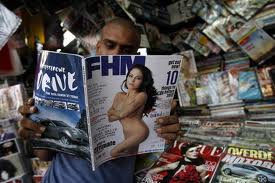
The FHM Cover: Pakistan outraged, but what about us Indians?


Here's one thing I don't understand about the FHM India controversy. Sure, Pakistan is outraged at both Veena Malik's nudity and the ISI tattoo. But what about us Indians? Isn't there any debate in India over this cover and its presence in our horrifyingly repressed Indian society? 
No, I am not a social conservative nor am I bore. Unfortunately, I am an Indian woman who has to navigate her way through the streets of India and doesn’t find it fun. Let your guard down for a minute, and there’s sure to be a random male body part brushing past you. Wear anything remotely provocative, and just the leers will make you run for cover. Even as women on screen and magazine covers compete to shed their clothes to get noticed, I find myself wishing for Harry Potter’s invisibility cloak to walk Mumbai’s streets. 
No, this is not a tirade against the Indian man and his roving hands either. I feel sorry for Indian men. They are amongst the most sexually repressed in the world and it couldn't be fun for them either. It leads to all kinds of perversities, the need to harass women on the streets being one of them.  
Lads magazine have similar covers in the West too. But they exist in a different sexual context: a context where men are not repressed and women know they can walk the streets without feeling violated. These covers merely act as a bit of fun and titillation here. 
But within an Indian context, how exactly should we view such covers, shoots, item numbers and porn stars on Bigg Boss doing pole dance numbers? Whom are they really liberating? Certainly not me, as I stand surrounded by leering men next to a Wheelers at Mumbai's train station with Veena Malik hanging naked above me. And certainly not the Indian man, for all he is getting is another image to take to toilet as he silently jerks-off to it. 
Meanwhile, Malik sues FHM for 100 million rupees, and FHM countersues her for 250 million rupees.